--%>

Net income by negative income tax

Under the negative income tax system demonstrated in this figure, a family of four along with no earned income would have a net after-tax income of: (1) $15,000 per year. (2) $10,000 per year. (3) $5,000 per year. (4) $2,500 per year. (5) $0 per year.
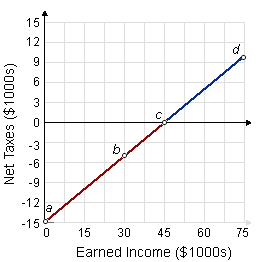
1671_Problem on Negative Income Tax.png

I need a good answer on the topic of Economics problems. Please give me your suggestion for the same by using above options.

   Related Questions in Microeconomics

  • Q : Supply of labor curve problem Can

    Can someone please help me in finding out the accurate answer from the following question. Employer with the monopsony power which as well had the ability to wage discriminate perfectly would tackle a marginal factor cost of labor

  • Q : Problem on market boundaries The

    The market’s boundaries are stated by: (i) Legislation. (ii) The number of sellers and buyers in the market. (iii) The ease of trading among sellers and buyers. (iv) Geographical borders. Choose the right ans

  • Q : What is the sum of market demand for a

    I have a problem in economics on what is the sum of market demand for a good. Please help me in the following question. The other things constant, market demand for the good is a sum of: (i) Firm’s utility-maximizing decisions. (ii) Amounts dema

  • Q : Selling price by price elasticity of

    At the point upon the demand curve for Silver Screen Classic DVDs, here the price elasticity of demand is unitary, the price would be approximately: (i) $10, resulting in roughly 8 million DVDs being sold. (ii) $13, resulting in appro

  • Q : Problem on monoplists Suppose that the

    Suppose that the total cost curve for a monopolist is provided by TC = 3y2 + 800 and its marginal cost curve is given as MC = 6y.  Also assume it faces a market demand curve of py = 280 - 4y and marginal revenue curve of MR = 280 – 8y.

  • Q : Demand for product when its sales fall

    When a 10% hike in the price of paisley socks causes sales to fall with 20%, the demand for such socks is: (1) perfectly inelastic. (2) relatively inelastic. (3) unitarily elastic. (4) relatively elastic. (5) perfectly elastic. <

  • Q : Influences on union nonunion wage

    Significant influences on union non-union wage differentials comprise the: (1) Proportion of an industry which is unionized and the frequency of strikes. (2) Frequency of strikes, inflation and the collective bargaining policies. (3) Collective bargai

  • Q : Wage differentials-union and nonunion

    I have a problem in economics on Wage differentials-union and nonunion workers. Please help me in the following question. The wage differentials among union and nonunion workers encompass historically averaged roughly: (i) 10% to 15 %. (ii) 5% to 10%.

  • Q : Profit maximization at the rate of

    At the rate of output, profits are maximized where marginal: (i) revenue is maximized. (ii) revenue equals marginal cost. (iii) revenue exceeds marginal cost by the greatest amount. (iv) cost is minimized. Can some

  • Q : Words of Joseph A. Schumpeter about

    According to Joseph A. Schumpeter as: (1) refined and popularized the idea that profits derive by innovation. (2) perceived profits as rewards for bearing uncertainty. (3) believed which monopoly firms are so inefficient which none fully realize their