--%>

Market experience increases in quantity supply

When equilibrium moves from point a to point b, the merely market experiencing raise within quantity supplied is demonstrated into: (w) Panel A. (x) Panel B. (y) Panel C. (z) Panel D.
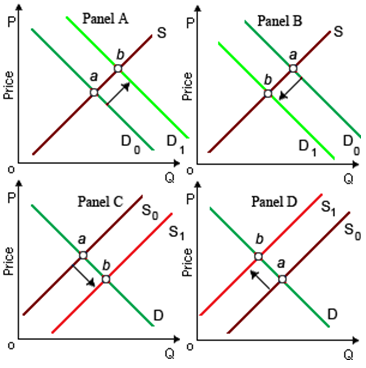
1174_Supply and Demand.png

Please guys help to solve this problem of economics with some explanation.

   Related Questions in Microeconomics

  • Q : Standard of Income Distribution

    According to the requirements standard of income distribution: (w) marginal productivity is easily measured. (x) people’s needs are proportional to their marginal products. (y) income must be distributed in proportion to people’s needs. (z

  • Q : Define Invisible items Invisible items

    Invisible items: All kinds of services that are rendered to or obtained from abroad are termed as invisible items. Such are invisible as these are not made up of any matter or material. The record of such items is not obtainable with the ports. Illust

  • Q : Law of demand in Ceteris Paribus Can

    Can someone help me in finding out the right answer from the given options. The law of demand supposes that the income and tastes of the consumers are: (i) Strong determinants of the prices. (ii) Causes of movements all along the demand curve. (iii) C

  • Q : Problem Based on Economic Rent Location

    Location or site rents are as: (w) unrelated to the geographic location of a firm in a market. (x) determined from the fertility of land. (y) generated while a firm’s location allows this to charge more for its output or to pay less for its inpu

  • Q : Union-Nonunion Wage Differentials I

    I have a problem in economics on Union-Nonunion Wage Differentials. Please help me in the following question. All else equivalent, when employment in an industry raises, the average wage differential gap among union and non-union workers: (1) Narrows.

  • Q : Law of supply regarding firms I have a

    I have a problem in economics on Law of supply regarding firms. Please help me in the following question. The law of supply signifies that: (i) Firms provide less for sale at lower prices. (ii) Purchases and prices differ inversely. (iii) Minimum inve

  • Q : Increase revenues when price falls When

    When the price elasticity of demand for fried cheesy grits at Pixie’s Breakfast Grill is two, in that case a price cut of $2.80 to $2.00 per serving of grits would be most probably to: (1) reduce Pixie’s revenues from grits by roughly fort

  • Q : Monopolies in the short run Monopolies

    Monopolies tend to shut down in the short run when: (1) price is less than the minimum of average total costs [ATC]. (2) price cannot cover all overhead costs. (3) potential revenue cannot cover total variable costs. (4) total costs exceed total reven

  • Q : Rolls of Intermediaries Upon the

    Upon the average, all intermediaries do NOT: (w) decrease the opportunity costs of goods to consumers. (x) raise the incomes of producers. (y) reduce transaction costs. (z) increase the cost of living. Hey friends

  • Q : Economic profit of purely-competitive

    This purely-competitive lumber mill experiences on the average day is an: (w) economic profit of about $340. (x) economic loss of roughly $150. (y) accounting profit of less than $300. (z) accounting loss of more than $100.

    Discover Q & A

    Leading Solution Library
    Avail More Than 1431056 Solved problems, classrooms assignments, textbook's solutions, for quick Downloads
    No hassle, Instant Access
    Start Discovering

    18,76,764

    1946084
    Asked

    3,689

    Active Tutors

    1431056

    Questions
    Answered

    Start Excelling in your courses, Ask an Expert and get answers for your homework and assignments!!

    Submit Assignment

    ©TutorsGlobe All rights reserved 2022-2023.