--%>

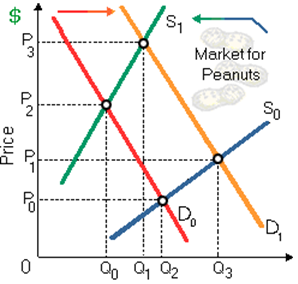
Market adjustment for new equilibrium at prices and quantity

This market for peanuts will adjust to a new equilibrium at price: (1) P0 and quantity Q0. (2) P1 and quantity Q0. (3) P2 and quantity Q2. (4) P3 and quantity Q1. (5) P1 and quantity Q1.
571_example of Equilibrium1.png

How can I solve my economics problem? Please suggest me the correct answer.

   Related Questions in Microeconomics

  • Q : Profit maximizing strategy Prohibition

    Prohibition Corporation would exactly break-even on its St. Valentine’s Day software when, in place of correctly identifying its profit maximizing strategy, this: (1) operated at point i, charging just $20 per copy and producing

  • Q : Price and output combination by demand

    Not like a purely competitive firm, here a profit-maximizing monopolist can: (w) charge any price it finds advantageous and be assured of selling all this produces. (x) select a price and output combination by a downward-sloping demand curve. (y) spen

  • Q : Interest rate in Determinants of Demand

    The demand curves for most of the nondurable consumer goods would be least influenced by modifications in: (i) Interest rates. (ii) House-hold income. (iii) Prices for related goods. (iv) Tastes and preferences. Ca

  • Q : Normative Standards for Distribution

    Relative to a requirements standard for distributing income, in that case the adoption of an equality standard would most likely tend to be: (w) unarguably fairer. (x) less bureaucratic. (y) more harmful to work incentives. (z) clearly less fair.

  • Q : Problem regarding to tax wedges in

    In equilibrium, a tax upon a good tends to because of the: (1) supply to exceed the demand. (2) quantity supplied to exceed the quantity demanded. (3) demand prices of consumers to exceed the supply prices of sellers. (4) competitive

  • Q : Copyrights in legal barriers to entry

    Legal barriers to entry do NOT comprise: (1) outright governmental prohibition of entry. (2) protection of inventions by patent. (3) licensing and bonding restrictions. (4) substantial economies of scale. (5) copyrights for music, computer software an

  • Q : Slope of indifference Curve State the

    State the slope of indifference Curve? Answer: Slope of indifference curve is equivalent to MRS, that is, Marginal Rate of Substitution.

  • Q : Backward bending-supply curve of labor

    Supply curve of the labor is LEAST probable to be ‘backward bending’ for: (i) An individual worker. (ii) The economy as an entire. (iii) Highly specialized industries which are major employers of the specialized PhDs hired only after 10 years of experience

  • Q : Marginal cost Give the answer of

    Give the answer of following question. Refer to the given data. The marginal cost of producing the sixth unit of output is: A) $24. B) $12. C) $16. D) $8. 432_f</span></p>
                                        </div>
                                        <!-- /comment-box -->
                                    </li>
   
   </td>
	</tr><tr>
		<td>
       
      <li>
                                        <div class=

    Q : Engel curve and the income effect I

    I can't get the answer of this question of Engel curve. Help me in determining answer of this question. Describe relationship between the Engel curve and the income effect?