--%>

Income effect at a wage rate

The substitution effect of a small change within the wage rate for this worker most strongly goes beyond the income effect at a wage rate of: (1) $5 per hour. (2) $10 per hour. (3) $10 per hour to $25 per hour. (4) $25 per hour to $40 per hour. (5) $40.01 per hour and up.
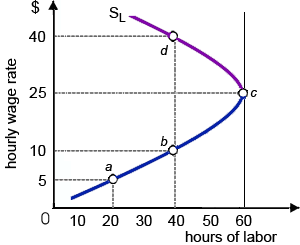
520_Problem on Supply of Labor.png

Can someone explain/help me with best solution about problem of Economics...

   Related Questions in Managerial Economics

  • Q : Diminishing Marginal Productivity of

    Workers tend to be less productive at the margin like they work along with increasingly huge amounts of: (w) physical capital. (x) personal human capital. (y) technology which makes them narrow specialists. (z) labor from other people on an assembly line.

  • Q : Substantial general training in firm A

    A firm which provides its workers along with substantial general training tends to: (1) retain such individuals by paying them the relatively highest wage premiums. (2) require workers to sign legal contracts of peonage and indenture. (3) increase wor

  • Q : Making a decision regarding resource

    To make a decision regarding resource hire, the firm should take as: (w) the price of the resource. (x) the productivity (Marginal Price) of the resource. (y) output prices. (z) All of the above. How can I solve my Economic

  • Q : Supplies of Labor within Competitive

    During a competitive resource market, every firm confronts a resource supply curve which is: (w) upwardly sloped. (x) backward bending. (y) perfectly inelastic. (z) perfectly elastic. I need a good

  • Q : Wage Rates and Marginal Resource Costs

    When all markets wherein a firm operates are purely competitive, in equilibrium the marginal resource cost of labor is the same to the: (w) firm’s marginal revenue. (x) marginal cost of output. (y) wage rate the firm must pay to hire more worker

  • Q : Use of Screening and Credentialism

    Critics of the wide use of screening and signaling within hiring practices argue which: (w) formal training is never very important in preparing workers with necessary skills. (x) worker credentials tend to be negatively related to productivity. (y) l

  • Q : Additional wage-elastic of demand A

    A firm’s demand for labor tends to be additional wage-elastic while: (1) the price elasticity of demand for output is greater. (2) substituting capital for labor is harder. (3) unskilled workers join unions. (4) labor costs are

  • Q : Best Potential Efficiency Wages

    Attempts to decrease shirking by paying workers more than they could earn within their next best potential jobs involves: (1) screening. (2) corporate acculturation. (3) efficiency wages. (4) signaling. (5) collective bargaining. H

  • Q : Backward Bending Labor Supplies The

    The graph for the supply of labor might be backward bending since: (w) the substitution effect surpasses the income effect at specific wages. (x) overtime workers receive pay for time and a half. (y) the substitution effect. (z) the income effect is m

  • Q : Forecasting demand what are the

    what are the criteria for good forecasting