--%>

Illustrates average variable cost curve

LoCalLoCarbo has become the favorite of fad dieters. There in curve E shows: (1) LoCalLoCarbo’s marginal cost curve. (2) LoCalLoCarbo’s average variable cost curve. (3) LoCalLoCarbo’s average total cost curve. (4) the market demand curve facing LoCalLoCarbo. (5) LoCalLoCarbo’s marginal revenue curve.
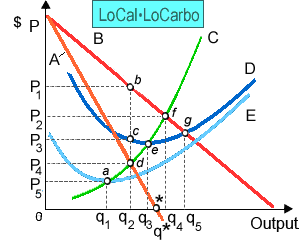
1846_Market Power and Marginal Revenue.png

Hello guys I want your advice. Please recommend some views for above Economics problems.

   Related Questions in Microeconomics

  • Q : Economic profit in the short run by

    This illustrated graph is most consistent along with the environment confronted through a: (w) purely competitive firm which makes economic profit within the short run. (b) monopolistically-competitive firm into long run equilibrium. (c) firm along with oligopoly powe

  • Q : Relatively price inelastic for prices

    Suppose that all these illustrated curves are infinitely long straight lines. Then supply curve which is relatively (although not perfectly) price inelastic for all prices and quantities is: (1) supply curve S1. (2) supply curve S2

  • Q : Economic profit of purely-competitive

    This purely-competitive lumber mill experiences on the average day is an: (w) economic profit of about $340. (x) economic loss of roughly $150. (y) accounting profit of less than $300. (z) accounting loss of more than $100.

    Q : Differnt types of demand and supply i

    i want to understand different market competitions using graphs and solving some problems

  • Q : Spending on rail safety ‘How be

    ‘How be supposed to the government decide whether to spend in additional rail safety measures?’

  • Q : Maintenance of monopoly power

    Maintenance of monopoly power is improved by: (1) natural barriers to entry. (2) large economies of scale. (3) artificial barriers. (4) legal barriers to entry. (5) All of the above. Hello guys I want your advice.

  • Q : Perfectly facing of all price takers

    All price-taker firms face absolutely: (w) elastic demand curves. (x) unitary supply curves. (y) inelastic demand curves. (z) inelastic output curves. Hey friends please give your opinion for the problem of

  • Q : Unitary price elasticity of demand The

    The output of RoboMaids consequent to the point where demand has unitary price elasticity is approximately: (i) 2,000 robots weekly. (ii) 4,000 robots monthly. (iii) 6,000 robots monthly. (iv) 10,000 robots monthly. (v) 13,000 robots monthly.

  • Q : Maximum possible economic profit of firm

    This firm’s maximum possible economic profit equals: (i) $12,000 per period. (ii) $16,000 per period. (iii) $20,000 per period. (iv) $24,000 per period. (v) $28,000 per period.

    Q : Maximizes total revenue by a monopolist

    A monopolist maximizes total revenue through producing where is: (w) marginal revenue = marginal cost [MR = MC]. (x) marginal revenue = 0. (y) demand is elastic. (z) demand is inelastic. How can I solve my