--%>

Highest legal price for Whopper Slushees

Beginning at equilibrium, a new highest legal price for Whopper Slushees set at P1 would: (i) cause people to purchase more Slushees and fewer cones from Dairy Queen. (ii) Reduce total market demand. (iii) Yield surplus demand and a scarcity. (iv) Increase net market supply. (v) Make surplus supply and a shortage.
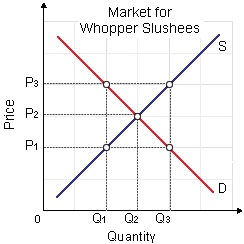
403_4.jpg

Can someone help me in getting through this problem.

   Related Questions in Microeconomics

  • Q : Human Capital-Individuals premium wages

    The firm which offers its workers by substantial specific training tends to: (i) Pay such individuals premium wages to try to make sure retaining such workers. (ii) Need workers to sign the legal contracts of indenture and peonage. (iii) Raise worker productivity appr

  • Q : Selling footballers-the economic

    State economic arguments on whether a football club must sell a significant player?

  • Q : Boycotts relating problem People who

    People who decline to buy the products of a firm whose activities they disapprove, especially whenever such rejection is intended to support the employees who are on strike, and who advise others to not purchase such products, or to not deal with these firms, are enga

  • Q : Characteristics of oligopoly Features

    Features of oligopoly: 1) Few sellers in the market 2) Firms sell homogenous or differentiated products. 3) Price Rigidity. 4) Behavior of each firms dependence on the other firms.

  • Q : Function of negative economic profits A

    A function of negative economic profits is to: (w) attract new firms into the industry. (x) keep competition within. (y) signal to other firms to invest their capital into this industry. (z) correct resource allocations by forcing firms generating los

  • Q : Profit Maximization in Resource Markets

    I have a problem in economics on Profit Maximization in Resource Markets. Please help me in the following question. To make a decision regarding resource hire, the firm should consider: (1) The price of resource. (2) The productivity (MP) of resource. (3) Output price

  • Q : When market for a good is in equilibrium

    Whenever the market for the good is in equilibrium, this signifies that the: (i) Demand and supply are equivalent. (ii) Tax wedge is perfectly offset by the government advantages. (iii) Differences among demand prices and supply prices equivalent profit per unit. (iv)

  • Q : Costs and Operating Decisions The firm

    The firm will stop the progress of it operations unless the firm’s owner(s) anticipate that future revenues will: (1) Produce an economic profit. (2) Cover the predicted totals of all future explicit and implicit costs. (3) Yield an accounting profit. (4) As wel

  • Q : Equilibrium price in the short run The

    The equilibrium price for Christmas trees in the short run is: (w) P1. (x) P2. (y) P3. (z) P4.

    Q : Purely and monopolistically competitive

    Purely competitive markets and monopolistically competitive markets have in general: (1) the collusive tendencies of large rival firms. (2) extensive negotiations about prices among buyers and sellers. (3) freedom of entry and exit wi