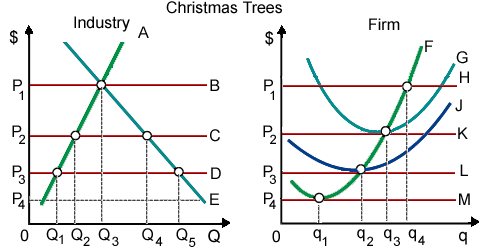
Equilibrium price in the short run
The equilibrium price for Christmas trees in the short run is: (w) P1. (x) P2. (y) P3. (z) P4. How can I solve my Economics problem? Please suggest me the correct answer.
The equilibrium price for Christmas trees in the short run is: (w) P1. (x) P2. (y) P3. (z) P4.
How can I solve my Economics problem? Please suggest me the correct answer.
These supply and demand curves for sugar propose that the: (1) demand price exceeds the supply price at quantity Q2. (2) technology should advance to allow output to develop to Q4. (3) quantity demanded equals quantity supplied at P1.
When this monopolistic competitor produces Q units, this is maximizing: (w) sales development and its market share. (x) total revenue. (y) economic profits. (z) total fixed cost and its managers' salaries.
Consumers shop for the lowest price probable for a good only till the expected benefits of shopping no longer go beyond the expected: (w) maximum legal prices for the good. (x) prices available in the black market. (y) transaction costs related with a
Lauren launched Staplex developed in Staplex, Iowa 10 years ago. The Staplex has expanded and now produces similar staplers in all ten of its factories extend across three continents. Staplex is the: (1) Horizontally integrated firm. (2) Monopoly cartel. (3) Diagonall
Can someone help me in finding out the most precise answer from the given options. Securing financing for the economic capital for a corporation can’t be accomplished by: (i) Issuing common stock. (ii) Issuing the corporate bonds. (iii) Securing the majority of
At any point on short-run supply curve of a competitive industry, every firm produces at the similar: (w) rate of technological equilibrium. (x) average cost. (y) marginal cost. (z) positive level of economic profit. Q : Proprietorships and Partnerships The The advantage of a partnership is: (i) Its ease of organization as compared to the corporation. (ii) Its limited liability. (iii) Its capability to outlive the partner’s death. (iv) The lack of divergences. C
The advantage of a partnership is: (i) Its ease of organization as compared to the corporation. (ii) Its limited liability. (iii) Its capability to outlive the partner’s death. (iv) The lack of divergences. C
Assume a neither firm possessing both the monopsony power as an employer and the market power in its output market, however which can neither wage discriminate nor price discriminate. In the equilibrium in its labor market for workers, of the given va
In equilibrium for any of profit-maximizing firm, marginal revenue product of the labor: (i) Is equivalent to the change in net revenue related with selling an extra unit of output. (ii) Surpasses the wage rate by maximum possible. (iii) Equivalents marginal factor co
I have a problem in economics on Definition of Industry. Please help me in the following question. The industry is stated as: (1) Each and every firm producing all final services and goods. (2) Each and every firm producing the similar product. (3) Th
18,76,764
1950542 Asked
3,689
Active Tutors
1451689
Questions Answered
Start Excelling in your courses, Ask an Expert and get answers for your homework and assignments!!