--%>

Determine income elasticity of demand

This given figure as in below demonstrates how the consumption of goods A, B, C and D differs as a family’s income changes. There income elasticity of demand equivalents 1 for: (w) good A. (x) good B  (y) good C. (z) good D.
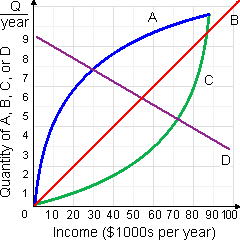
2414_Income Elasticity of Demand.png

Please choose the right answer from above...I want your suggestion for the same.

   Related Questions in Microeconomics

  • Q : Estimate price by price elasticity of

    At the point on the demand curve for RoboMaids where the price elasticity of demand is unitary, the price would be roughly: (i) $10,000, resulting in sales of roughly 16,000 robots monthly. (ii) $13,000, resulting in sales of approxim

  • Q : Economic profits by competitive

    Economic profits produce competitive pressures which cause: (w) each firm’s output to shrink during the short run. (x) an industry’s output to increase. (y) market prices to increase. (z) firms to leave an industry.

    Q : Explain about term market failure The

    The phrase "market failure" refers to: (w) the failure of market economies to deal with social problems. (x) the Stock Market Crash of 1929. (y) cases where supplies and demands within private markets yield inefficiency, excessive or inequity instabil

  • Q : Determine profit per unit of output

    Price minus average total cost i.e., P - ATC equals: (w) total profit. (x) marginal cost. (y) marginal revenue. (z) profit per unit of output. Please choose the right answer from above...I want you

  • Q : Labor Force Participation Rates The

    The percentage of a specific population who is either unemployed or employed or is termed as the: (i) Labor force participation rate. (ii) Work-force proportion. (iii) Income-leisure loss curve. (iv) Substitution effect dominance rate. (v) Labor supply.

  • Q : Pricing strategy In a competitive

    In a competitive pricing strategy how does one can arrive for a multi-service practice where there are no specific products in question?

  • Q : Raise current consumption by rising in

    When interest rates rise, in that case the opportunity costs of: (1) current consumption rise. (2) future consumption rise. (3) current investment decline. (4) government budget deficits decline. (5) saving grows proportionally.

  • Q : Long-run supply curve in constant cost

    When cranberries are a constant cost industry and that firm is typical, in that case the industry’s long-run supply curve is curve as: (i) curve A. (ii) curve B. (iii) curve C. (iv) curve D. (v) curve E.

    Q : Charging price by long run operating

    Most monopolists whom continue to operate in the long run are capable to charge a price as: (w) greater than minimum average total costs [ATC]. (x) less than MR. (y) less than marginal costs [MC]. (z) less than which of a pure competitor along with si

  • Q : Barriers to entry and long run

    A firm which realizes an economic profit in the short run will carry on generating economic profits in the long run only when: (i) it maximizes economic revenue. (ii) barriers to entry prevent entry from rival firms. (iii) its managers minimize princi