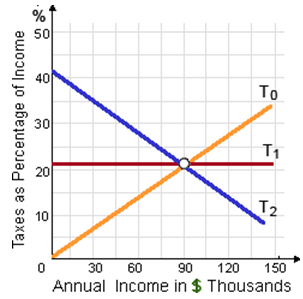
Describe proportional in taxes as percentage of income
Line T1 depicts in given graph as in below a tax system which is: (i) progressive. (ii) recessive. (iii) proportional. (iv) biased. (v) regressive. Hello guys I want your advice. Please recommend some views for above economics problems.
Line T1 depicts in given graph as in below a tax system which is: (i) progressive. (ii) recessive. (iii) proportional. (iv) biased. (v) regressive.
Hello guys I want your advice. Please recommend some views for above economics problems.
Bobby Lee’s dairy has gainfully expanded beyond butter, fresh milk and cheese, by providing Organizmic Fertilizer, guided by ATV tours for the visitors, and Granny Lee’s Exfoliating Body Yogurt. The Clyde County Business News trumpets that the Bobby Lee ha
Price discrimination generally harms: (w) all consumers and benefits firms along with market power. (x) all firms along with market power and benefits all consumers. (y) some consumers, when helping sellers and several other consumers. (z) all sellers
Law of Diminishing Merginal utility: This states that as consumer consumes more and more units of commodity, the utility derived from each and every successive unit goes on decreasing. According to this law TU increases at decreasing rate and the MU d
Assume a neither firm possessing both the monopsony power as an employer and the market power in its output market, however which can neither wage discriminate nor price discriminate. In the equilibrium in its labor market for workers, of the given va
The purely competitive industry’s demand for the labor is: (i) Less elastic than the horizontal summation of individual firm’s demands. (ii) Perfectly elastic. (iii) Upward sloping as of the diminishing marginal returns to labor. (iv) Equi
Both level of the employment by a firm and the average rate of monopsonistic exploitation of labor are raised when a firm is capable to: (1) Outsource by hiring low productive workers in the foreign countries. (2) Replace the workers with automation by an industrial r
The consumer who spends income and hence the ratio of MUs of all goods purchased equivalents the ratio of their prices is: (i) Maximizing net utility. (ii) Spending too much. (iii) Beyond the point of diminishing negative utility. (iv) Behaving incompatibly through pu
From about 1890 till 1970, the “structure-conduct-performance paradigm” dominated theories concerning how firms behave in various kinds of markets. The word “conduct” in this context refers to these things as: (i) decisions by
By 2000, the differential among the rich and the poor which can be attributed to economic discrimination was computed at: (w) approximately 60 percent. (x) approximately 30 percent. (y) under 10 percent. (z) zero.
Carlos and Ivana are room-mates and friends. Carlos and Ivana eat together despite who cooks on a given night. Within this payoff matrix, Nash equilibrium could never be obtained in that: (w) neither Carlos nor Ivana cook, nor do they eat. (x) Carlos
18,76,764
1940539 Asked
3,689
Active Tutors
1439321
Questions Answered
Start Excelling in your courses, Ask an Expert and get answers for your homework and assignments!!