--%>

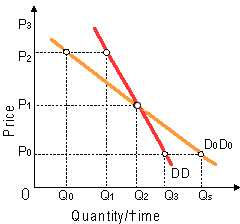
Demand curves relatively more elastic at price

Scrutiny of demand curves DD and D0D0 reveals such that: (1) D0D0 is relatively more elastic at a price of P1. (2) DD is relatively more elastic at a price of P2. (3) D0D0 probably reflects the demand for a biological necessity. (4) DD most likely represents the demand for a good along with more close substitutes. (5) price elasticity is constant along DD but not along D0D0.
1545_Slope and Elasticity2.png

I need a good answer on the topic of Economics problems. Please give me your suggestion for the same by using above options.

   Related Questions in Microeconomics

  • Q : Constant-cost in short-run

    In a constant-cost, there purely-competitive industry in the short-run: (w) and long-run supply curves are positively sloped. (x) and long-run supply curves are negatively sloped. (y) and long-run supply curves are horizontal. (z) sup

  • Q : Economies of scale exist in range of

    Natural monopoly refers to a market or industry in that: (w) economies of scale exist across much of the complete range of market demand. (x) superior management enables a firm to remove its competitors. (y) a firm produces a good protected through pa

  • Q : Differences in the arc elasticities of

    The dissimilarities in the arc elasticities of demands for labor among the Ajax Corporation and Bosun Limited are consistent along with an inference which Bosun: (1) is a more profitable firm than Ajax. (2) hires more highly skilled workers than Ajax

  • Q : Arising of natural monopolist Natural

    Natural monopolies arise due to: (w) artificial barriers to entry. (x) contestable markets. (y) price discrimination. (z) natural barriers to entry. I need a good answer on the topic of Economics p

  • Q : Interdependent decision of oligopolies

    Interdependent decision making through firms is most common within: (w) purely competitive industries. (x) monopolized industries. (y) oligopolies. (z) monopolistic competition. Please choose the right answer from

  • Q : Kinked demand curves and sticky prices

    Sticky prices within oligopoly markets are: (w) predicted by the kinked demand curve model. (x) substantiated by many statistical studies. (y) most common for highly differentiated products. (z) a result of price discrimination.

    Q : Reducing prices due to a commodity

    Which of the given would NOT be taken as predatory behaviour: (w) Rapid technological innovation. (x) Reducing prices due to a commodity surplus. (y) Duplicative products intended to absorb shelf space. (z) Introduction of close substitutes for rivals

  • Q : Generates price and a quantity

    All prospective suppliers [sellers] would be in equilibrium when this market for teleporter buttons created a price and a quantity consistent along with: (1) eliminating the shortage Q1-Q3 existing at P3. (2) any point along the demand

  • Q : Drive rivals out of business A firm may

    A firm may temporarily lower prices as well as earn negative profits in trying to: (w) drive rivals out of business. (x) find rivals to lower prices. (y) maximize current profit. (z) A rational firm would not do this.

    Q : Reflecting normal substitution by

    When consumer demand for this industry’s product is relatively inelastic, in that case the curve reflecting normal substitution although the least price elasticity of market demand would be of: (i) curve A. (ii) curve B. (iii) curve C. (iv) curv