--%>

Constant cost industry with no barriers to entry or exit

When consumers eventually cannot distinguish one roasted chicken dinner from other, while roasted chicken dinners are produced into a constant cost industry, and when no barriers to entry or exit exist, so this firm’s long-run economic profit will be about: (1) $29,000 per week. (2) $31,500 per week. (3) $34,000 per week. (4) $36,500 per week. (5) zero per period.
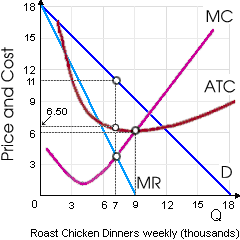
1006_Market Power and Short Run Economic Profit.png

Please choose the right answer from above...I want your suggestion for the same.

   Related Questions in Microeconomics

  • Q : Meritocracy in System of Distribution

    An emphasis onto socioeconomic mobility based upon equality of opportunity, independently of inheritances of land or else physical capital, which is a centerpiece of a system of distribution termed as: (1) meritocracy. (2) laissez faire capitalism. (3

  • Q : Normative Economics and Income

    The fundamental economic question probably to generate answers heavily based into debatable value judgments is: (1) what goods will society produce? (2) how will resources be used to yield the goods society chooses to produce? (3) to whom will the goo

  • Q : Net revenues problem When your firm

    When your firm generates ski boats, your net revenues from selling given numbers of ski boats would be influenced least by: (1) Raised prices for jet skis. (2) Pay hikes for dock-workers. (3) Government increasing fees for boat licenses. (4) Vacatione

  • Q : Problem on wage discrimination Firms

    Firms which discourage the workers from discussing their salaries or wages are most likely engaged in the policies of: (i) Respect for the worker’s privacy. (ii) Monopolistic exploitation. (iii) Perfect competition. (iv) Cooperation rather than competition. (v)

  • Q : Determine price of unitary price

    St. Valentine’s Day software is currently going in version of 6.0. At this point on the demand curve where the price elasticity of demand is unitary, there the price would be approximately: (i) $20, resulting in roughly 16 milli

  • Q : Constant-cost in short-run

    In a constant-cost, there purely-competitive industry in the short-run: (w) and long-run supply curves are positively sloped. (x) and long-run supply curves are negatively sloped. (y) and long-run supply curves are horizontal. (z) sup

  • Q : Decreasing Marginal Utility Can someone

    Can someone help me in finding out the right answer from the given options. The diminishing marginal utility law defines that: (i) Net utility rises up to a point and then reduces as more units of good are consumed. (ii) Net utility reaches a negative value if the goo

  • Q : Limit Pricing Strategy When an

    When an incumbent firm uses an edge pricing strategy: (w) this can maximize short run profits and discourage entry in the market. (x) this may not be maximizing short run profits, but this can make positive economic profits over the long run. (y) the

  • Q : Increase total revenue and exceeds

    When a firm along with market power raises the price of a good a little, total revenue as: (w) falls in the inelastic range of the demand curve. (x) rises over the elastic range of the demand curve. (y) stays close to zero in the unit

  • Q : Why demand curve is more elastic Why

    Why demand curve is more elastic under monopolistic competition as compare to monopoly.