--%>

Compute Gini Index

The areas illustrates in this Lorenz diagram can be used to compute a Gini index as: (i) (cow + pig)/cow. (ii) cow2/(cow + pig).  (iii) pig2/(cow + pig). (iv) cow/(cow + pig) (v) (cow + horse)/pig.
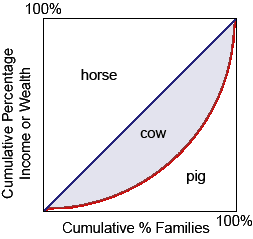
997_Lorenz Curve Problem.png

Can anybody suggest me the proper explanation for given problem regarding Economics generally?

   Related Questions in Microeconomics

  • Q : Maximized output level and zero

    When all production costs for a monopoly are fixed [MC =0], in that case economic profit: (i) falls when price is raised in the inelastic range of a demand curve. (ii) rises when price is cut in the inelastic range of

  • Q : Unitarily elastic demand by fixing all

    A monopolist who does not price discriminate, that is: (w) cannot maximize profit by producing where demand is unitarily elastic. (x) will maximize profit where demand is unitarily elastic when all costs are fixed. (y) will maximize profit where deman

  • Q : Problem on Rate of Exploitation The

    The difference among the value of marginal product of the labor and average wage rate will tend to be maximum when a firm: (i) Joins significant market power in output market and monopsony power in the labor market, however does not wage discriminate. (ii) Is a pure c

  • Q : Total cost for monopolistic competitor

    Total cost for that monopolistic competitor in shown below figure equals area: (w) 0cbQ. (x) 0deQ + dcbe. (y) 0paQ   cpab. (z) All of the above.

    Q : Profit margins Examine within your

    Examine within your answer the circumstances that will enable a company to pass on cost increases to customers and protect profit margins. For example- price sensitivity of demand, rising food prices, cotton prices, etc.

  • Q : Product Differentiation During product

    During product differentiation, the firms attempt to: (w) become price takers. (x) gain a degree of market power over their pricing and sales of their products. (y) increase the supply of their products. (z) raise the price elasticity of the demand fo

  • Q : Market demand curve Market demand curve

    Market demand curve: The market demand also rises with a fall in price and vice-versa. In figure below the quantity demanded by

  • Q : Long run adjustments in industry

    Associate to short-run supply curves, in long-run industry supply curves tend to be additionally: (i) vertical. (ii) positively-sloped. (iii) profitable. (iv) income inelastic. (v) price elastic. C

  • Q : Output and equilibrium price Hybrid

    Hybrid Roses is the merely florist in 60 miles of Presidio, Texas. Often, lots of Texans are romantics at heart. Total cost curve of Hybrid is below the demand curve this faces. At its output and equilibrium price, Hybrid will produce

  • Q : When would transaction cost be zero All

    All transaction costs would be zero when: (1) Congress required current prices to be cut by eighteen percent. (2) market information and transportation were both costless. (3) market prices were legally restricted to production costs. (4) inflation we