--%>

Break even and zero economic profit at entry and exit

Within the long run, after HoloIMAGine’s holographic technology patents lapsed moreover entry and exit became probable in this market, therefore HoloIMAGine would be expected to: (w) carry on to reap economic profits. (x) break even and experience zero economic profit. (y) have zero accounting profit. (z) operate at inefficiently low levels of output.
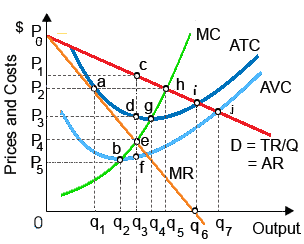
2355_Market Power1.png

Can someone explain/help me with best solution about problem of Economics...

   Related Questions in Microeconomics

  • Q : Price cut of Substitutes products When

    When a price cut for licorice gummy bears decrease the demand for tuna fish ice-cream, then: (1) Tuna fish ice-cream and licorice gummy bears are the complementary goods. (2) Price hikes for tuna fish ice-cream will decrease the demand for the licorice gummy bears. (3

  • Q : Corollary of the law of equal marginal

    The corollary of the law of equal marginal benefit is the principle of: (1) Equal marginal utilities per dollar. (2) Diminishing marginal utility. (3) Income injection. (4) Substitution in demand. (5) Diminishing returns. Can someo

  • Q : Drive rivals out of business A firm may

    A firm may temporarily lower prices as well as earn negative profits in trying to: (w) drive rivals out of business. (x) find rivals to lower prices. (y) maximize current profit. (z) A rational firm would not do this.

    Q : Natural barriers to entry A monopoly

    A monopoly may emerge naturally while: (w) increasing costs happen quickly relative to market demand. (x) at low levels of output, disutilities of scale are encountered. (y) economies of scale are substantial relative to market demand. (z) variable co

  • Q : Meaning of surplus in current price I

    I have a problem in economics on Meaning of surplus in current price. Please help me in the following question. The surplus of potting soil signifies that the current price: (1) Makes an surplus demand. (2) Is above the equilibrium. (3) Surpasses the

  • Q : Purely competitive decreasing cost

    When a decreasing cost industry is purely competitive in that case: (1) each firm’s long-run supply curve is downward sloping. (2) each firm encounters increasing returns to scale. (3) growth of industry output yields lower per unit costs. (4) c

  • Q : Common type of firm among in monopolist

    The most common kind of competition in between firms within monopolistic competition is: (i) price competition. (ii) product differentiation. (iii) collusion. (iv) predatory pricing. (v) cutthroat competition. Hell

  • Q : Problem on Open Shops Whenever a firm

    Whenever a firm hires workers in spite of of whether the workers pay union dues, then this is: (i) A closed shop. (ii) A union shop. (iii) An agency shop. (iv) An open shop. (v) A scab shop. Choose the right answer from the above o

  • Q : Consuming equal successive units of good

    The idea that additional satisfaction ultimately declines from consuming equivalent successive units of any good is the law of: (1) Consumer deficits. (2) Equivalent marginal utilities per dollar. (3) Diminishing marginal utility. (4) Veblen’s inequality. (5) Co

  • Q : Total utility and marginal utility Can

    Can someone please help me in finding out the accurate answer from the following question. The paradox of the value (also termed as the diamond-water paradox) occurs from: (1) High transaction costs. (2) Low transaction costs. (3) Failures to differentiate among the m