--%>

Analysing the Probabilities

1. In the waning seconds of Superbowl XLVII, the Baltimore Ravens elected to take a safety rather than punt the ball. A sports statistician wishes to analyze the effect this decision had on the probability of winning the game.

(a) Which two of the following probabilities would most help the statistician perform his analysis? P(Win¦Safety); P(Safety¦Win); P(Punt¦Win); P(Win¦Punt); P(Win); P(Win∩Safety), P(Win∩Punt)?

(b) Define (in words) what the probabilities that you selected in part (a) mean and explain (in words) why they would be useful to the analysis.

2. Let A1;A2, and A3 be events in Ω. Show that P(A1 ∩ A2 ∩ A3) = P(A1¦A2 ∩ A3)P(A2¦A3)P(A3).

3. Let A and B be events such that P(A) > 0 and P(B) > 0. Show that P(AjB) = 1 - P(A¦B)

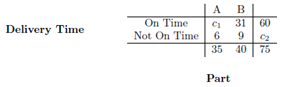
4. A business is keeping track of how many of two parts A and B are ordered, and whether those orders are completed on time or late. The data is in the table below.
1373_mandeep.png

(a) Find c1 and c2.

(b) Do type of part ordered and delivery time appear to be independent?

(c) A customer calls and angrily complains that the part he ordered was late without giving any more details. Which type of part did the customer most likely order?

5. A medical company is developing a new test for breast cancer. Based on lab results, the test appears to have 90% specicity (the percentage of all women without the disease that the test correctly identies) and 95% sensitivity (the percentage of all women with the disease that the test correctly identies). Suppose that 12% of women who take this test have breast cancer.

(a) What is the false positive rate for this test?

(b) What is the false negative rate for this test?

(c) How will the false positive and false negative rates for this test be a ected if the percentage of women with breast cancer decreases?

6. An urn contains a red ball, a white ball, a green ball, and a plaid ball. A single ball is randomly drawn from the urn. Let A be the event that either the red ball or the plaid ball is drawn, let B be the event that either the white ball or the plaid ball is drawn, and let C be the event that the green ball or the plaid ball is drawn.

(a) What is P(A υ B υ C)?

(b) Are A, B, and C independent from each other?

(c) Are A, B, and C mutually independent?

7. You have two decks of cards in front of you. One deck is a standard 52 card deck with four aces. The other also has 52 cards, but eight aces instead of four. You randomly choose a deck and draw two cards without replacement.

(a) What is the probability of drawing at least one ace?

(b) Given that you drew at least one ace, what is the probability that you drew from the standard deck?


   Related Questions in Advanced Statistics

  • Q : Statistics Homework with SAS File is

    File is attached, need it by 8:30 AM Pacific (Seattle, WA) time. No delay acceptable. Need it March 25, 2014 on 8:30 AM Pacific time.

  • Q : Probability and Statistics

    Instructions: Do your work on this question and answer sheet. Please print or write legibly, and, as always, be complete but succinct. Record your answer and your supporting work in the designated space. Explain your method of solution and be sure to label clearly any

  • Q : Analytical Report Hi I WOULD LIKE TO

    Hi I WOULD LIKE TO KNOW IF YOU CAN HELP ME TO DO THE ASSIGNMENT IN HEALTH STATISTICS THANKS

  • Q : Probability on expected number of days

    It doesn't rain often in Tucson. Yet, when it does, I want to be prepared. I have 2 umbrellas at home and 1 umbrella in my office. Before I leave my house, I check if it is raining. If it is, I take one of the umbrellas with me to work, where I would leave it. When I

  • Q : True and False Statement Discuss the

    Discuss the following statements and explain why they are true or false: a)      Increasing the number of predictor variables will never decrease the R2 b)      Multicollinearity affects the int

  • Q : MANOVA and Reflection Activity 10:

    Activity 10: MANOVA and Reflection 4Comparison of Multiple Outcome Variables This activity introduces you to a very common technique - MANOVA. MANOVA is simply an extension of an ANOVA and allows for the comparison of multiple outcome variables (again, a very common situation in research a

  • Q : Null hypothesis In testing the null

    In testing the null hypothesis H0: P=0.6 vs the alternative H1 : P < 0.6 for a binomial model b(n,p), the rejection region of a test has the structure X ≤ c, where X is the number of successes in n trials. For each of the following tests, d

  • Q : How you would use randomization in

    The design of instrument controls affects how easily people can use them. An investigator used 25 students who were right-handed to determine whether right-handed subjects preferred right-handed threaded knobs. He had two machines that differed only in that one had a

  • Q : Non-parametric test what is the

    what is the appropriate non-parametric counterpart for the independent sample t test?

  • Q : Problem on consumers marginal utility

    Consider a consumer with probability p of becoming sick.  Let Is be the consumer’s income if he becomes sick, and let Ins be his income if he does not become sick, with Is < Ins. Suppo