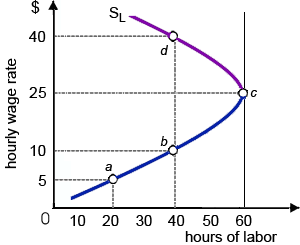
Wage rate and labor in supplying
By the following choices in this illustrated graph, this worker would be happiest at point: (w) point a. (x) point b. (y) point c. (z) point d. Please choose the right answer from above...I want your suggestion for the same.
By the following choices in this illustrated graph, this worker would be happiest at point: (w) point a. (x) point b. (y) point c. (z) point d.
Please choose the right answer from above...I want your suggestion for the same.
Illustrates the responsibilities of managerial economists?
Boris operates a local landscaping company, needs each potential employee to lift a 200 pound tree before being hired whole-time. This obligation is an example of: (1) signaling. (2) discrimination. (3) screening. (4) derived demand. (5) automation. Q : Negatively bending Labor Supplies An An individual’s labor supply curve is negatively sloped that is backward-bending into a range of wages while the: (i) demand for goods exceeds the demand for leisure. (ii) worker offers more hours of labor while the wage rate in
An individual’s labor supply curve is negatively sloped that is backward-bending into a range of wages while the: (i) demand for goods exceeds the demand for leisure. (ii) worker offers more hours of labor while the wage rate in
If this firm maximizes profit, this will be producing under circumstances of: (1) increasing returns to labor. (2) economies of scale. (3) diminishing returns to labor. (4) constant returns to labor. (5) adverse selection and moral hazard. Q : Wage Flexibility An assumption An assumption regarding purely competitive labor markets to make sure market clearing is which: (w) firms maximize profit. (x) individuals and households maximize utility. (y) wages and prices are flexible. (z) trade unions engage in collective bargai
An assumption regarding purely competitive labor markets to make sure market clearing is which: (w) firms maximize profit. (x) individuals and households maximize utility. (y) wages and prices are flexible. (z) trade unions engage in collective bargai
During a competitive resource market, every firm confronts a resource supply curve which is: (w) upwardly sloped. (x) backward bending. (y) perfectly inelastic. (z) perfectly elastic. I need a good
This supply of labor of worker is perfectly inelastic at point: (w) point a. (x) point b. (y) point c. (z) point d. Q : Differentiate between Private Cost and Differentiate between Private Cost and Social Cost.
Differentiate between Private Cost and Social Cost.
Illustrates the Expert Opinion method of Demand Forecasting?
Illustrates the steps in formulating pricing policies in details?
18,76,764
1926014 Asked
3,689
Active Tutors
1426339
Questions Answered
Start Excelling in your courses, Ask an Expert and get answers for your homework and assignments!!