--%>

Utility with food coupons

Question:

In Vancouver the Salvation Army encourages people to make food voucher donations to panhandlers instead of simply giving them cash. You can buy a food voucher for $5 and give it to a panhandler who can use it to purchase food. The Salvation Army says it's a way to ensure that a gift actually goes to food, rather than alcohol or drugs. Suppose a panhandler (PH) consumes two goods: food (F) and drugs (D). The PH has a utility function u = F0D1. This can also be written as u= D. Answer and explain the following using a diagram which is completely labeled.

(a) If drugs and food each cost $1 per unit, and the PH has $20 is cash, how much D and F will he consume.

(b) If instead the PH has $10 in cash and $10 in food vouchers, how much D and F will he consume?

(c) Is the PH better off with $20 in cash, or with $10 in cash and $10 in food vouchers.

Solution:

a)

u = D

PH will only consume drugs. This is because food does not give him additional utility. Whether he consumes 0 units or 1000000 units of food, it does not make a difference. Therefore, he will spend all his income on drugs. He will consume 20 units of drugs.
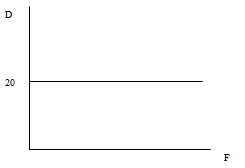
758_additional utility.png

b)

In this case, he will consume 10 units of drugs, and he is indifferent between consuming 0 units or 10 units of food.
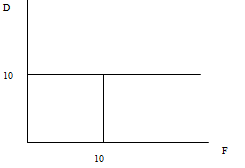
968_Utility with food coupons.png

c) Utility with $20 cash = 20

Utility with food coupons = 10

Therefore, PH is better with $20 cash.

   Related Questions in Business Economics

  • Q : Gains from the Exchange Even people who

    Even people who are extremely good at everything couldn’t encompass: (i) absolute benefits in approximately everything. (ii) Much higher incomes than average. (iii) Comparative benefits in everything. (iv) Superior natural endowments of talent.

    Q : Production possibilities curve is a

    How a production possibilities curve is a graphical representation of choices?

  • Q : Explain increased global competition

    Explain increased global competition?

  • Q : Strategic behaviour of decisionmaker If

    If one decisionmaker in interdependent circumstances calibrates its decisions to the anticipated reactions of the other party, in that case the decisionmaker is engaged within: (1) psychological forecasting. (2) profit maximization. (3) collusion. (4) strategic behavi

  • Q : Illustrates inverse relationship

    Illustrates the inverse relationship between price and quantity?

  • Q : What is an inverse relationship Briefly

    Briefly explain the use of graphs as a way to present economic relationships. What is an inverse relationship?

  • Q : Cornerstone of typical economic theory

    The cornerstone of typical economic theory derived through the work of Jeremy Bentham was the perception of (i) the wages fund. (ii) natural checks on population. (iii) increasing cost. (iv) utility. (v) surplus value.

    Q : Sources of not tax revenue Provide some

    Provide some sources of not tax revenue? Answer: Escheat, income from public enterprises, special assessment, fees and fines and so on.

  • Q : Economic crisis situation in Europe

    Question: Describe the present economic crisis situation in Europe.   Why has it been so difficult for the Europeans to find a solution to this problem?   Comment on what implications the crisis may have for the rest of the world i

  • Q : Elucidate types of unemployment

    Elucidate types of unemployment?