--%>

Under negative income tax the net income

Under the negative income tax system demonstrated in this figure, where a family of four all along with earned income of $60,000 yearly would have a net [after-tax] income of: (1) $37,500 per year. (2) $42,500 per year. (3) $50,000 per year. (4) $55,000 per year. (5) $60,000 per year.
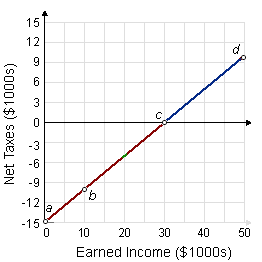
1122_Negative Income Tax Problem.png

How can I solve my Economics problem? Please suggest me the correct answer.

   Related Questions in Microeconomics

  • Q : Define change in demand Change in

    Change in demand: When change in demand takes place due to change in factor other than price, it is termed as change in demand.

  • Q : Monopsony power in the labor market The

    The firm with monopsony power in labor market: (1) Can hire any significant amount of labor devoid of affecting the wage. (2) Can pay any wage it wishes. (3) Must pay a higher wage when it hires more labor. (4) Must pay a lower wage when it hires more

  • Q : Forward-Shifting of Tax This would be

    This would be most complicated for resource owners to forward-shift a tax onto: (w) capital. (x) accounting profit. (y) land. (z) labor. Can someone explain/help me with best solution about problem of Econo

  • Q : Describing monopoly Illustrate the term

    Illustrate the term monopoly?

  • Q : Less marginal revenue then price charged

    For a nondiscriminating monopolist, there marginal revenue is: (w) profit per unit minus cost per unit. (x) total revenue per unit minus total cost per unit. (y) the modification in total revenue divided by the modification in total c

  • Q : Featherbedding in the practice of hiring

    The summation of monopolistic exploitation across all the workers tends to raise however a firm as well operates at a more socially and economically proficient level of output and employment whenever the firm is capable to engage in: (m) Blacklisting in its dealings t

  • Q : Signals between buyers and sellers In

    In the competitive market economy, most of the prices: (i) Make sure high incomes for the bureaucrats. (ii) Free resources and ration free goods. (iii) Act as a signal among sellers and buyers. (iv) Are set by the govt.

    Q : Problem on law of demand Let think

    Let think about the law of demand. The idea that a big price for a normal good will outcome in less of the good being bought never based logically on the: (i) Income effect. (ii) Demand for the good falling since of the higher price. (iii) Law of redu

  • Q : Total costs by charges

    When LoCalLoCarbo produces the profit-maximizing quantity and charges the profit-maximizing price, in that case its total costs equal the area of the rectangle as: (i) 0P3cq2. (ii) bdP4P1. (iii) 0P4

  • Q : Principle of equal marginal utilities

    The thought that, in equilibrium, the more you pay for the good, more it is worth (that is, at the margin) to you is most intimately associated to the: (1) Law of diminishing returns. (2) Equivalent satisfaction corollary. (3) Veblen effect. (4) Rising cost hypothesis