--%>

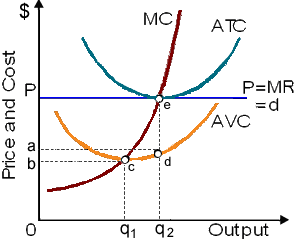
Typical pure competitor firm in industry

When this firm is a typical pure competitor within this industry as in demonstrated figure, then the firm is: (i) making normal accounting profit. (ii) making zero economic profit. (iii) breaking even. (iv) into an industry within long run equilibrium. (v) All of the above.
2281_Fixed Costs.png

How can I solve my Economics problem? Please suggest me the correct answer.

   Related Questions in Microeconomics

  • Q : What is technological advance Broadly

    Broadly defined, technological advance: A) can occur in either the short run, long run, or very long run. B) comprises new and improved goods and services and new and improved ways of producing or distributing them. C) includes invention, but not innovation or diffusi

  • Q : Simple circular flow model The simple

    The simple circular flow model illustrates that: A) households are on the buying side of both product and resource markets. B) businesses are on the selling side of both product and resource markets. C) households are on the selling side of the resource market and on

  • Q : Economic profit at profit-maximizing

    HoloIMAGine has patented a holographic technology which makes 3-D photography obtainable to consumers. When HoloIMAGine produces its profit-maximizing output, this is demonstrated as: (w) operating in the long run. (x) realizing an economic profit equ

  • Q : Demands for consumer for resources

    Since demands for resources eventually depend upon consumers’ demands for goods, in that case the demand for labor is: (w) termed as a derived demand. (x) a perfectly elastic demand curve. (y) a perfectly inelastic demand. (z) a horizontal line.

  • Q : Inelastic proportion of demand in

    This profit-maximizing firm in illustrated graph will never knowingly generate: (w) where MR is positive. (x) where MR is falling. (y) on the elastic proportion of the demand curve. (z) on the inelastic proportion of the demand curve.

    Q : Poverty and Human Capital Enabling

    Enabling labor to move out of low-wage occupations by enhancing their education, skills, training and mobility, which will tend to: (w) lower the wages of those who leave the low wage occupation. (x) raise the wages of those who remain in the low wage

  • Q : Spending pattern for maximizing utility

    The consumer maximizes utility if spending patterns cause: (1) Level of net utility to increase each time purchases are modified. (2) Marginal utilities of each and every good consumed to be equivalent. (3) Principle of corresponding marginal utilities per dollar to b

  • Q : Existence of purely competitive farm in

    This purely competitive rose farm would most likely exit in this industry with the long run when the wholesale price per dozen roses fell below: (i) $4.50 per dozen roses. (ii) $5.00 per dozen roses. (iii) $5.50 per dozen roses. (iv) $6.00 per dozen r

  • Q : Equivalent marginal revenue product

    When a monopolist is maximizing its gain in the product market however consists of no monopsony power in labor market, and then it will: (1) Hire labor till marginal revenue product equivalents the average factor cost. (2) Pay a wage equivalent to the marginal revenue

  • Q : Labor Union Goals-Minimum employment

    Can someone please help me in finding out the accurate answer from the following question. When a union achieved the maximum possible hourly wage: (i) All of the members would be pleased. (ii) Employment would as well be maximized. (iii) Employment would be at minimum