--%>

Total variable cost when maximizes economic profits

Total variable cost when this firm maximizes economic profits would be: (i) $12,000 per period. (ii) $24,000 per period. (iii) $32,000 per period. (iv) $48,000 per period. (v) $60,000 per period.
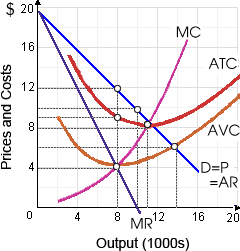
138_Price Discrimination.png

Hey friends please give your opinion for the problem of Economics that is given above.

   Related Questions in Microeconomics

  • Q : Problem on deadweight loss Assume that

    Assume that the domestic demand for television sets is explained by Q = 40,000 − 180P and that the supply is provided by Q = 20P. When televisions can be freely imported at a price of $160, then how many televisions would be generated in the domestic market? By

  • Q : Long-run supply in constant cost

    Within a constant-cost industry: (w) short-run supply is totally elastic. (x) long-run supply is completely elastic. (y) short-run supply is fully inelastic. (z) long-run supply is wholly inelastic. I need a good a

  • Q : Monopolies in short run Within the

    Within the short run, there monopolies can: (i) make economic profits. (ii) break even. (iii) make economic losses. (iv) All of the above. Hey friends please give your opinion for the problem of Economics <

  • Q : Characteristics of purely competitive

    Characteristics of purely competitive markets do not comprise: (w) homogeneous products. (x) large numbers of potential buyers. (y) large numbers of potential sellers. (z) the capability of sellers to set prices. I

  • Q : Labor Supply-Elasticity I have a

    I have a problem in economics on Labor Supply-Elasticity. Please help me in the following question. When we try to list the labor supplies from least elastic to the most elastic, then the most accurate ranking would most likely be: (i) Competitive fir

  • Q : Free products Select the right answer

    Select the right answer of the question .Free products offered by firms :1) may or may not be free to society, but are never free to individuals. 2) may or may not be free to individuals, but are never free to society. 3) are poduced and distributed at no cost to soci

  • Q : Corporations stockholders not liable

    The corporation’s stockholders are not personally liable for the debts of firm since: (1) The Corporation is considered as a legal person, separate from its owner. (2) Usually there are too many stockholders to try to hold them all accountable. (3) In a corporat

  • Q : Preference current consumption over

    When the preference for current consumption over future consumption weakens, in that case the: (w) interest rate rises. (x) interest rate falls. (y) present value of future income falls. (z) equilibrium level of investment falls.

  • Q : Limitation of marginal revenue Marginal

    Marginal revenue is NOT: (i) similar as average revenue or price for a competitive firm. (ii) identical to the price of output for firms along with monopoly power. (iii) specified by (change in TR)/ (change into Q) for all firms. (iv) derived by the d

  • Q : Third degree price discrimination Firm

    Firm A has no costs of production and sells its products to just two buyers. The buyers (1 and 2) have the following demand functions: P1 = 90 -10q1 P2 = 60 - 5q2 (a) Assuming that the rm can engage in third degree price discrimination, nd the