--%>

Supply of labor by increase in wages rate

If the wage rate increases from $25 per hour to $40 per hour, in that case the elasticity of the supply of labor from this worker is roughly: (i) zero. (ii) 7/15. (iii) 13/15. (iv) one. (v) minus 13/15.
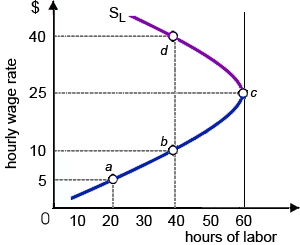
837_Problem on Supply of Labor.png

I need a good answer on the topic of Economics problems. Please give me your suggestion for the same by using above options.

   Related Questions in Managerial Economics

  • Q : Succeed and surviving of a cartels A

    A cartel is more likely to succeed and survive when: (w) members respond to incentives to cheat. (x) fringe producers are not members. (y) total market demand is less elastic. (z) close substitute goods are simply developed.

    Q : Technology advances in Economic Growth

    Can someone help me in finding out the right answer from the given options. The production possibilities frontier enlarges if: (i) The economy approaches full and proficient employment. (ii) Technology progress. (iii) Society's net demand for output i

  • Q : Income effect of a small wage rate

    The income effect of a small change within the wage rate for that worker most strongly exceeds the substitution effect at a wage rate of: (1) $5 per hour. (2) $10 per hour. (3) $10 per hour to $25 per hour. (4) $25 pe

  • Q : HW Hello, Would you please find a small

    Hello, Would you please find a small case study in managerial economics. please I don't want the typical solution because the prof have it. thanks

  • Q : Introduction of the term Margin of

    Provide a brief introduction of the term Margin of Safety?

  • Q : Advantages and disadvantages of Survey

    What are the advantages and disadvantages of survey techniques?

  • Q : Illustration of specific training The

    The knowledge gained while an Apple employee learns a specialized technique on an iPod assembly line is an illustration of: (w) comparative technological advantage. (x) specific training. (y) on-the-job leveraging. (z) general training.

    Q : Investment in human capital in market

    Most economists would categorize the bulk of the funds spent upon your college education like: (1) an investment in human capital. (2) financial capitalization. (3) consumption. (4) specific training. (5) personal saving. Please gu

  • Q : Screening and Credentialism Critics of

    Critics of “credentialism” believe which firms making employment decisions tend to rely much heavily on: (1) personal contacts. (2) past experience. (3) personality testing. (4) job interviews. (5) formal training and education.

  • Q : Labor and Diminishing Returns All else

    All else equal, employees will eventually be less productive: (w) the greater is the amount of physical capital. (x) when they receive more certain training and less general knowledge. (y) if the wage rate is increased. (z) as more and more people are put on an assemb