--%>

Supply of Labor

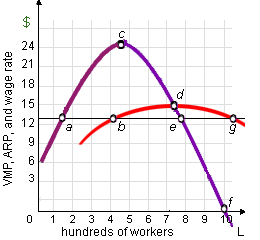
The firm in this illustrated graph is clearly: (1) price taker in the sale of its output because of the shapes of the VMP and MRP curves. (2) price taker in the purchase of labor when this can hire as several workers as this chooses at roughly of $13 per hour. (3) monopsonist since it should increase the wage rate to hire more labor. (4) monopolist since it should cut the price of its output to sell more product (5) polygamist.+
1546_Problem on Demand for Labor.png

How can I solve my Economics problem? Please suggest me the correct answer.

   Related Questions in Managerial Economics

  • Q : Define the inelastic demand Define the

    Define the inelastic demand.

  • Q : Dependency of labor supplies Labor

    Labor supplies depend on wage rates and also: (w) labor force participation and capital availability. (x) worker skills and preferences regarding employment. (y) technology and the price of output. (z) labor force participation and derived demand.

  • Q : Illustrates the conditions of price

    Illustrates the conditions of price discrimination?

  • Q : Elasticity of Demand for Labor The

    The elasticity of demand for labor is directly associated to: (w) labor’s share of total costs. (x) the elasticity of demand for output. (y) the ease of substitution between labor and other resources. (z) All of the above.

    Q : Total Explain the meaning of total,

    Explain the meaning of total, average, marginal and incremental revenue.

  • Q : Explain about the control of business

    Explain about the control of business cycle.

  • Q : Derived Demand in Competitive Labor

    Derived demand refers to: (w) consumer demand for products, based on expected utility. (x) government demand for social goods, based upon tax revenue. (y) business demand for resources, based upon consumer demand for products. (z) supplier demand for

  • Q : Concavity in production possibilities

    Concavity (or bowed-out shapes) in production possibilities frontiers is described least fine by: (i) The law of diminishing returns. (ii) Resources being unevenly suited for various forms of production. (iii) Rising opportunity costs. (iv) Non-neutra

  • Q : Employment Screening If job applicants

    If job applicants are asked for letters of recommendation and copies of their college transcripts, in that case a firm is practicing: (1) wage discrimination. (2) employment screening. (3) job signaling. (4) a structural employment system (5) credentialism.

  • Q : Reason of an unexpectedly good

    An unexpectedly good agricultural harvest because of the: (w) profits of most speculators to soar. (x) population growth rate to accelerate. (y) market demand and price to increase. (z) quantity of food demanded to develop. I need