--%>

Substitution effect of wage rate

The substitution effect of a small change within the wage rate dominates the income effect for that worker at each wage rate: (w) exceeding $5 per hour. (x) between $5 per hour and $24.99 per hour. (y) exceeding $25.01 per hour. (z) between $25.01 per hour and $40 per hour.
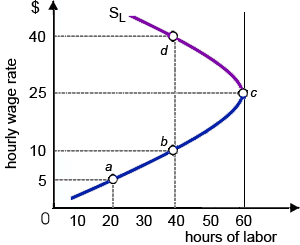
260_Problem on Supply of Labor.png

I need a good answer on the topic of Economics problems. Please give me your suggestion for the same by using above options.

   Related Questions in Managerial Economics

  • Q : Evan J Douglass definition of

    What is the Evan J Douglas’s definition of Managerial economics?

  • Q : Human Capital Accumulation and the

    A society’s stock of human capital would be least probable to grow as a consequence of: (w) federal subsidies for college education. (x) sustained unemployment during a recession. (y) apprenticeship programs for construction workers. (z) retrain

  • Q : Define the term full cost concept

    Define the term full cost concept.

  • Q : Supply of certain types of labor The

    The supply of certain types of labor is determined through the: (w) skills of potential workers. (x) the availability of other workers. (y) the prices of output. (z) production technology. I need a good answer on the topic of

  • Q : Signaling and Screening Problem Assume

    Assume that you view a degree as a ticket to a high-paying job along with prospects of quick promotion, and that accumulating human capital by learning and studying valuable material is largely not relevant. Your perception is which a college degree f

  • Q : Diminishing Returns and Increasing Costs

    I have a problem in economics on Diminishing Returns and Increasing Costs. Please help me in the following question. The concave (or bowed out) production possibilities frontier means that the opportunity costs are: (i) Constant (ii) Increasing (iii)

  • Q : Marginal Productivity Theory The

    The economic theorist most famed for developing marginal productivity theory was: (1) Thorstein Veblen. (2) Karl Marx. (3) Alfred Marshall. (4) John Bates Clark. (5) Vilfredo Pareto. Can someone ex

  • Q : Opportunity costs of purely financial

    By a purely financial perspective, you must stop going to school while you: (w) graduate from college. (x) have to take out educational loans at interest rates which exceed the inflation rate. (y) face opportunity costs of education exceeding the expe

  • Q : Profit price by earning in Human capital

    As per demonstrated in this graph, there average college graduate will earn around: (1) $12,000 yearly. (2) $20,000 yearly. (3) $45,000 yearly. (4) $90,000 yearly. (5) $100,000 yearly.

    Q : Explain the aspects of operational or

    Explain the aspects of operational or internal issues.