--%>

Short run operations of a profit-maximizing pure competitor

This figure in below is demonstrates the operations of a profit-maximizing pure competitor into the: (1) market period. (2) short run. (3) long run. (4) super long run since this can alter technology. (5) shutdown range of production.
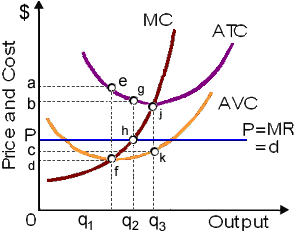
1627_profit-maximizing.png

Hey friends please give your opinion for the problem of Economics that is given above.

   Related Questions in Microeconomics

  • Q : Economic profit of purely competitive

    Purely competitive firms will experience economic profit, in a short-run equilibrium which is: (w) zero. (x) positive. (y) negative. (z) negative, zero, or positive are all possibilities. Hey friends please give yo

  • Q : Goods of negative income elasticity of

    When the income elasticity of market demand is negative, in that case most consumers view the good as: (w) a luxury good. (x) having several imperfect substitutes. (y) an inferior good. (z) a normal good. Hey frien

  • Q : Spending on rail safety ‘How be

    ‘How be supposed to the government decide whether to spend in additional rail safety measures?’

  • Q : Effects of Moral Hazard When you pay a

    When you pay a straight A student in advance to write your term-paper and that person spends money on the party and then decides not to do a fine job and hence you wind-up with an F for submitting sloppily written gibberish, you have just suffered since of: (i) Advers

  • Q : Comparable the changes in TC and TVC

    Tell me the answer of this question. In comparing the changes in TC and TVC associated with an additional unit of output, we discover that: A) the change in TVC is equal to MC, while the change in TC is equal to TFC. B) the change in TC exceeds the change in TVC. C) t

  • Q : Price ceilings and price floors Price

    Price ceilings and price floors: 1) cause surpluses and shortages respectively. 2) make the rationing function of free markets more efficient. 3) interfere with the rationing function of prices. 4) shift demand and supply curves and therefore have no effect on the rat

  • Q : Market Power and Demand for Labor All

    All of the given might causes labor markets to be non-competitive except: (i) Backward bending labor supply curves. (ii) Unions and employer trade associations. (iii) Monopolistic power exercised by the firm. (iv) Monopsonistic power exercised by the

  • Q : Economic concept of total costs I have

    I have a problem in economics on Economic concept of total costs. Please help me in the following question. The economic concept of total costs and the bookkeeper’s concept of net costs differ as economists: (1) Place a lower value on the psychi

  • Q : Common type of firm among in monopolist

    The most common kind of competition in between firms within monopolistic competition is: (i) price competition. (ii) product differentiation. (iii) collusion. (iv) predatory pricing. (v) cutthroat competition. Hell

  • Q : Illustration of demand for Spurs tickets

    Can someone help me in finding out the precise answer from the given options. In the year 2005, the San Antonio Spurs basketball team increased all ticket prices and attendance surpassed the year 2004 attendance, pointing out a raise in the: (i) Upward slope of ticket