--%>

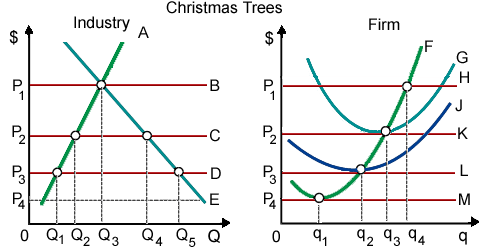
Shifting supply of curve by entry of firms

When the price for Christmas trees is initially P1, in that case in the long run: (w) firms will neither enter nor exit this industry. (x) entry of firms will shift curve supply curve A to the right. (y) exit of firms will shift supply curve A to the left. (z) entry of new firms will shift that firm’s curve F to the right.
1091_supply and demand1.png

Can anybody suggest me the proper explanation for given problem regarding Economics generally?

   Related Questions in Microeconomics

  • Q : NO profit-maximizing firm in long run

    In the long run no profit-maximizing firm would produce yet a level of output at that: (w) marginal revenue is below the price charged consumers. (x) demand is relatively price inelastic. (y) total revenue would exceed total variable costs but not tot

  • Q : Oligopolistic markets in equilibrium

    Oligopolistic markets in equilibrium are described by: (w) a large number of sellers of homogeneous output. (x) monopolistic sellers dealing along with only some buyers. (y) a small number of sellers of close substitutes. (z) socially optimal amounts

  • Q : A legal price floor and revenues Assume

    Assume that the U.S. wheat market is firstly into equilibrium on S0D0. Now assume the government institutes a legal price floor at P3 per bushel of wheat. When the government does nothing else, one outcome will be such

  • Q : Competition in Labor Markets The

    The horizontal labor supply curve signifies that: (i) The supply of labor is perfectly inelastic. (ii) The firm can hire as much labor as it requires at going wage rate. (iii) Labor and capital are in the fixed supply. (iv) Marginal physical product of the labor is co

  • Q : Numerical question regarding demand At

    At $1.50 per gallon, Alana purchases 50 gallons of gasoline weekly, Bart purchases 20 gallons weekly, and Caitlin purchases 20 gallons weekly. One point on their joint demand curve for gasoline would be Q =: (1) 90 gallons per week, P = $1.50. (2) 90 gallons per week,

  • Q : Attract new firms by economics profits

    Economic profits within a competitive industry are signals which: (i) attract new firms into the industry. (ii) hinder innovation of new technologies. (iii) encourage inefficiency in existing firms. (iv) business conditions are deteriorating. (v) pric

  • Q : Budget for in-kind transfer payment

    Current budgets for transfers “in-kind” have developed most significantly for spending upon: (w) Medicare and Medicaid. (x) food stamps. (y) public housing. (z) grants to expand educational opportunity.

  • Q : Consumer demands-technologies used by

    Consumer demands for the caviar are least possible to change in response to modifications in: (1) Technologies utilized by workers who harvest caviar. (2) Government taxes or subsidies on the caviar. (3) Prices for other delicacies people eat on the festive occasions.

  • Q : Elasticity of supply when price hike

    When a $5 price hike raises the number of tanks of dehydrated water supplied in this market from point e to point f, the elasticity of supply: (i) 2.333. (ii) 2.000. (iii) 1.667. (iv) 1.333. (v) 0.600. How can I so

  • Q : Total economic of profit or loss on

    When the wholesale price P = $7 per bushel of peaches, it purely competitive peach orchard maximizes profit via producing ___ bushels of peaches at a total economic of profit or loss totaling $___. (i) zero; loss; -$4,000. (ii) 2000;