--%>

Setting price and produces an output

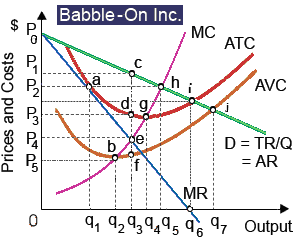
Assume that Babble-On’s patents for speech-translation software covering 314 languages lapsed, as well as entry of new competitors within this market eroded the demand for Babble-On software, but the firm retains several market powers since competitors’ products are not perfect substitutes. Assume that the new demand curve facing Babble-On is precisely its previous marginal revenue curve. Therefore babble-On would be expected to: (w) produce q2 output since minimum average variable cost corresponds to point b. (x) set its price equal to P2 and produce output q1. (y) exit the industry because its maximum possible accounting profit is zero. (z) operate at a level of output which exceeds the efficient level for society as a entire.
1067_Market Power.png

Hello guys I want your advice. Please recommend some views for above Economics problems.

   Related Questions in Microeconomics

  • Q : Percent of interest rate for the price

    When the Bank of England issues perpetuities which pay of £100 yearly, forever, beginning one year by today, in that case at an interest rate of 5 percent the price of that bonds is: (1) £9,500. (2) £5,000. (3) £2,000. (4) &pou

  • Q : Decision processes in Microeconomics

    Decision processes within households, and government and firms and the consequences of such decisions are initially the focus of: (1) positive economics. (2) public choice economics. (3) microeconomics. (4) normative economics. (5) microeconomics.

  • Q : Determine highest incomes at specific

    Salespeople as illustrated in graph who earn percentage commissions upon the total revenue from DVD games would create their highest incomes at specific price of: (w) $50. (x) $25. (y) $10. (z) zero.

    Q : Various kinds of capital goods Supply

    Supply curves for different kinds of capital goods are usually: (w) perfectly elastic. (x) perfectly inelastic. (y) upward sloping. (z) downward sloping. Can anybody suggest me the proper explanati

  • Q : Quantity of good supplied-Law of supply

    The law of supply states that the amount of a good supplied is: (i) Legally governed by the production regulations. (ii) Inversely related to its absolute price. (iii) Recognized by the consumer tastes in the free market economy. (iv) Positively relat

  • Q : Find unskilled labor for no minimum

    When there is no minimum legal wage in market for unskilled labor, approximately: (w) 6,000 unskilled workers would earn about $5 per hour. (x) 3,000 unskilled workers would earn about $8 per hour. (y) 4,500 unskilled workers would ea

  • Q : Profit-maximizing price and output

    Unlike a purely competitive firm, a monopolist can: (w) select a price and sell as much as this needs (x) equate marginal revenue as well as marginal cost to maximize profits. (y) produce any required amount and sell as much as this d

  • Q : Maximum economic profit operates in new

    When this competitive firm operates at point d in demonstrated graph, in that case this: (w) could increase profits by expanding output to q5. (x) maximizes economic profit [ as area P2P1de], but these profits will eva

  • Q : Prospective financial investment by

    Assets turn into less desirable to prospective financial investors while: (w) they become more liquid. (x) interest rates increase. (y) their prices go up. (z) default risks decrease. How can I solve my Eco

  • Q : Economic losses driven down to zero

    Exit by a competitive industry will arise till economic: (1) profits are driven to zero. (2) profits counterbalance accounting losses. (3) incomes are equalized for comparable workers. (4) costs are sufficiently below accounting losses. (5) losses are driven down to z