--%>

Resource prices

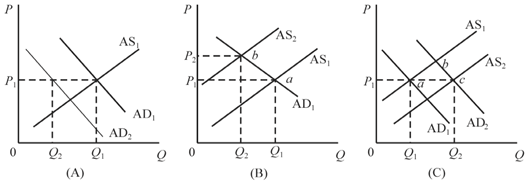
Refer to the following diagrams, in which AD1 and AS1 are the "before" curves and AD2 and AS2 are the "after" curves. Other things equal, a decrease in resource prices is depicted by:1) panel (A) only. 2) panel (B) only. 3) panel (C) only. 4) panels (B) and (C)
 

880_2.png

Help me to go through this problem.

   Related Questions in Microeconomics

  • Q : Calculation of total fixed cost of a

    Hello friends I need your help to solve the problem that is given below: This firm's total fixed cost (TFC) can be calculated as area: (a) 0PeQ. (b) bPec. (c) aPed. (d) 0bcQ. (e) abcd.

    Q : Jurisdictional Strikes The Taft-Hartley

    The Taft-Hartley Act prohibited strikes against a firm over the issue of which of the two or more competing unions would symbolize the firm’s employees. These strikes are termed as: (i) Jurisdictional strikes. (ii) Strategic representation strikes. (iii) Wildcat

  • Q : Differences in site values An acre of

    An acre of Manhattan is worth additional than an acre of prime Iowa farm land due to differences in: (1) perpetuities. (2) time preferences. (3) site values. (4) interest rates. (5) taxes. Can someone explain/help me with best solu

  • Q : Market demand of purely competitive

    How purely competitive industries respond to raises in market demand depends upon: (w) the time period considered. (x) immediate quantity adjustments and longer run price adjustments. (y) each firm’s average total costs. (z) the slope of the mar

  • Q : Market Power and Monopsony Power-

    Assume that a firm with market power in the output market wants to develop and that hiring more workers needs it to raise salaries 8 percent for all the workers. Output prices will most likely: (i) Increase 8 percent to cover the wage rise. (ii) Increase less than 8 p

  • Q : Features of monopolistic competition

    Why Features of monopolistic competition is monopolist in nature? Answer: (a) Control over price (b) Downward sloping demand curve

  • Q : Downward-sloping demand curve The law

    The law of demand is graphically demonstrated by: (1) Movement all along the supply curve. (2) The downward-sloping demand curve. (3) The rightward shift of demand curve. (4) Shifting of production possibilities. C

  • Q : Measure Liquidity An asset’s associate

    An asset’s associate “liquidity” is inversely measured through the: (w) transaction costs in dealing within the asset as a proportion of the market price of the asset. (x) time it takes to convert this to cash. (y) “backing&rdq

  • Q : Price elasticity of demands for moving

    Moving from point d to point e beside demand curve D, the price elasticity of demands of DVDs of video games at equal: (a) 0.8. (b) one. (c) 1.10. (d) 1.25. (e) 2.50

    Q : Reform welfare mess Proposals to reform

    Proposals to reform the “welfare mess” comprises: (w) increasing education levels. (x) increasing job training programs. (y) enforcement of the Equal Pay Act. (z) negative income taxes. How can I solve