--%>

Ratio of perfect equality and Lorenz curve

The ratio of the area between the perfect equality reference line and the Lorenz curve is the: (w) Gini index. (x) relative income (y) poverty line (z) marginal productivity standard.
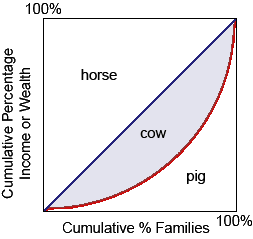
1082_Lorenz Curve Problem.png

Please choose the right answer from above...I want your suggestion for the same.

   Related Questions in Microeconomics

  • Q : Economic inefficiency per unit of output

    When this firm cannot price discriminate, after that the rate of economic inefficiency per unit of output which its exercise of market power yields equals to: (i) area 0PbQ0. (ii) distance af. (iii) area 0fcQ0. (iv) distance bc. (v) r

  • Q : Easily enter or exit the market in the

    This graph depicts a short run situation while long run equilibrium has been achieved for a firm along with some market (price-making) power when the firm cannot price discriminate and: (w) has explicit costs but no i

  • Q : Existence of elasticity from zero to

    Each negatively sloped linear demand curve consists of: (1) variable slope. (2) price elasticity coefficients which increase when the price falls. (3) price elasticity which range from zero to infinity. (4) a price elasticity of one at whole points. (5) an inelastic region above

  • Q : Determine price when quantity demand

    If the demand for a good is price elastic, in that case the percentage change in quantity demanded into response to a specified change within price is: (1) greater than the percentage change in price. (2) positively related to the cha

  • Q : Completely controls output of a product

    Through the strict economic description that a monopoly is: (i) necessarily a very large firm. (ii) one of a few large firms that dominate a market. (iii) a lone firm which completely controls the output of a product along  with no close substitu

  • Q : Transaction Costs-Process of trial and

    In an uncertain globe, people are supposed to try to make best use of their satisfaction by: (1) Determining in advance the mixture of goods that maximizes the utility and then purchasing this mix. (2) The procedure of trial and error. (3) Making marginal decisions ti

  • Q : Needs a goal of maximizing by

    The long run survival of a purely-competitive firm needs a goal of maximizing: (i) managerial salaries. (ii) total costs. (iii) economic profits. (iv) total revenue. (v) fixed costs to minimize variable costs. How

  • Q : More unit gains marginal revenue by

    A firm which can sell each and every unit of its production at a price of $200 and that sells 500 more units gains marginal revenue by the additional units of: (w) $500,000. (x) $100,000. (y) $200. (z) $10,000. I n

  • Q : Marginal revenue of price taker firm A

    A price-taker firm’s marginal revenue is: (w) constant and identical to price. (x) less than average revenue. (y) sufficient to cover all short-run costs. (z) determined by the firm’s supply curve.

    Q : Price elasticity of demand at high and

    Moving by left to right along demand curve D, then price elasticity of demand for cheesy fried grits of Pixie is mostly: (w) positive, then unitary, then negative. (x) constant and equivalent to one. (y) greater at high prices than at low prices. (z)