--%>

Quantity demands equivalent quantity supply

These supply and demand curves for sugar propose that the: (1) demand price exceeds the supply price at quantity Q2. (2) technology should advance to allow output to develop to Q4. (3) quantity demanded equals quantity supplied at P1. (4) market experiences a shortage at P2. (5) government has set an effectual price floor at P02.
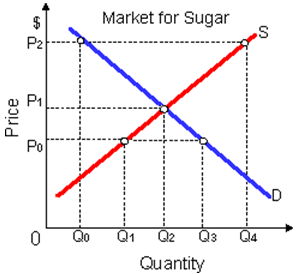
1875_example of Equilibrium.png

How can I solve my economics problem? Please suggest me the correct answer.

   Related Questions in Microeconomics

  • Q : Evidence for Diminishing Marginal

    Evidence that may potentially be cited as conflicting with the law of diminishing marginal utility would comprise: (i) Della’s enthusiasm for all-you-can-eat buffet diminishes subsequent to her fifth plate of lasagna. (ii) Jethro trades in his 1981 Gremlin on th

  • Q : What is Imperfect data Imperfect data :

    Imperfect data: Most studies start with imperfect data. Few datasets involve the entire population of interest. Typically, the data has been gathered by others for specific purposes, and as such may have built in b

  • Q : Wage Discrimination-supply labor curve

    The employer with monopsony power which as well had the capability to wage discriminate perfectly would confront the marginal factor cost of the labor curve: (i) Similar to the supply of labor curve it faces. (ii) Lower than the supply of labor curve it faces. (iii) H

  • Q : Amount of output supplied and price

    The amount of output supplied is exactly proportional to the price therefore the price elasticity of supply equivalents one into: (w) Panel A. (x) Panel B. (y) Panel C. (z) Panel D.

    Q : Infinite price elasticity of supply The

    The price elasticity of supply in given grph is infinite therefore supply is perfectly price elastic within: (w) Panel A. (x) Panel B. (y) Panel C. (z) Panel D.

    Q : Determine economic rent by annual income

    The philosophers in this demonstrated graph are enjoying economic rent equal to: (w) shaded area A. (x) shaded area B. (y) shaded area C. (z) the sum of the shaded areas.

    Q : Examples of pairs of complementary goods

    I have a problem in economics on Examples of pairs of complementary goods. Please help me in the following question. The illustrations of pairs of complementary goods would comprise: (1) Coffee and tea. (2) Butter and margarine. (3) Motor boats and wa

  • Q : Decrement in opportunity costs and

    Opportunity costs and prices tend to be decreased by: (w) competition among speculators and other intermediaries. (x) price floors. (y) the exercise of monopoly power. (z) price ceilings. How can I

  • Q : Problem on surplus inventories When the

    When the market price for soccer balls is above the intersection of supply and demand curves, then: (1) Shortages of soccer balls will be extensive. (2) Pressure will exist to raise the price of soccer balls. (3) Salaries paid people who make soccer balls are probable

  • Q : Difference between opportunity cost and

    Differences among the opportunity cost of a purchase through a consumer and the seller’s price are increased through: (w) taxes. (x) intermediaries. (y) competition. (z) speculators. Can anyb