--%>

Purely competition on the average

This purely competitive brickyard as in below graph on the average experiences an: (w) economic profit of about $135 per day. (x) economic loss of roughly $150 per day. (y) accounting profit of less than $100 per day. (z) accounting loss of more than $100 per day.
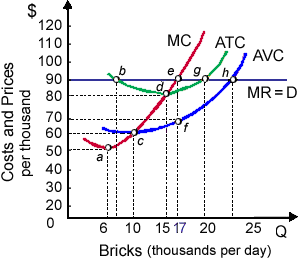
2285_Profit Maximization1.png

Can someone explain/help me with best solution about problem of Economics...

   Related Questions in Microeconomics

  • Q : Problem on bonds and interest rate The

    The _______ price for a lately issued bond signifies that the firm issuing the bond is paying the _______ interest rate to borrow the funds. (1) Lower; lower. (2) Lower; higher. (3) Higher; higher. (4) None of the above. The interest rate is fixed.

    Q : Marginal social benefit and costs under

    Under pure competition, there is marginal social benefit will equivalent marginal social cost unless: (w) “hit and run” entrepreneurs prosper. (x) economic profits are zero. (y) there are externalities. (z) entrepreneurs a

  • Q : Liabilities for damages and penalties

    Can someone please help me in finding out the accurate answer from the following question. The Caveat venditor is an ancient legal doctrine which encourages: (i) Consumer exploitation. (ii) a ‘buyers beware’ approach. (iii) Enforcement of the seller’

  • Q : Exploitation and the wage rate problem

    Assume a neither firm possessesing both the monopsony power as an employer and market power in its output market, however which can neither wage discriminate nor the price discriminate. In equilibrium, in its labor market for the workers, the following variables the m

  • Q : Hiring labor for Profit Maximization

    When the marginal revenue product of the very last worker hired is more than the marginal resource cost of the worker, then the firm: (1) Is experiencing rising returns to the scale. (2) Can raise its gains by hiring more labor. (3) Is maximizing the profit. (4) Must

  • Q : Present Value of a Perpetuity When the

    When the interest rate is 5%, in that case the present value of a perpetuity which pays $500 each year beginning a year by today equals: (1) $500. (2) $1000. (3) $2500. (4) $5000. (5) 10,000. Can s

  • Q : Price elasticity beside horizontal

    Hey FRIEND I need your help for query as given below: The price elasticity beside a horizontal demand curve is constant at: (w) zero. (x) infinity. (y) 1. (z) -1. Can someone ex

  • Q : Profit-maximizing unregulated monopoly

    No profit-maximizing unregulated monopoly will function in the inelastic portion of the demand curve this faces since: (w) marginal revenue is negative. (x) total revenues are negative. (y) total revenue falls as less is produced. (z) marginal revenue

  • Q : Quantity of good supplied-Law of supply

    The law of supply states that the amount of a good supplied is: (i) Legally governed by the production regulations. (ii) Inversely related to its absolute price. (iii) Recognized by the consumer tastes in the free market economy. (iv) Positively relat

  • Q : Problem Regarding to Lorenz Curves A

    A Lorenz curve is a way to demonstrate: (w) that the U.S. has perfect equality of income distribution. (x) a mirror image of a production-possibility curve. (y) the percentages of families receiving different percentages of income. (z) differences wit