--%>

Problem on siyazama production possibilities frontier

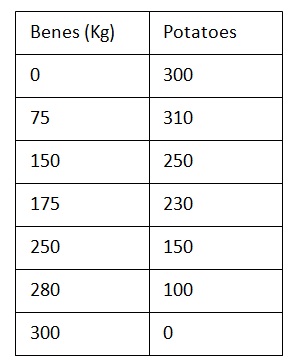
The table below  contains information about  the production possibilities frontier ( PPF or PPC)  of siyazama agricultural cooperative.
354_ques2.jpg


A) Plot a fully  labelled diagram to illustrates siyazama  production possibilities  frontier.
(Plot  the production of potatoes on the  x axis)

B) what  is the opportunity cost of increasing the production  of beans form 150Kg to 175Kg ?

C) What  is the significance of the points of the PPF?

D) Is  it possible for  siyazama agricultural cooperative to increase the production of beans and potatoes to 320 and 360Kg respectively? Support  you answer.

E) What  do the points ( Level  of production) inside the PPF  indicate?

F) How  can the PPC model  be used as a management tool in your  organization?

E

Expert

Verified

Siyazama’s production possibilities frontier with production of potatoes on the x-axis is below. The shape of the frontier indicates the principle of increasing cost, since production of more of one product will result in the sacrifice of larger amounts of the other product.

1206_frontier.jpg

In moving the production of beans from 150kg to 175kg, 25kg of beans are gained at the expense of 20kg of potatoes. Thus the opportunity cost of 25kg of beans is 20 kg of potatoes.

The points A to G on the PPF indicates the most efficient use of resources by the company. In order for the firm to produce more beans, it must give up some of the resources it employs to produce potatoes (point A). If the firm produces more potatoes (represented by points B to F), the firm must divert resources from making beans and simultaneously it will make less beans than it is producing at point A. In order for the firm to produce more potatoes, it must give up some of the resources it employs to produce beans (point G). However, these points A to G indicate the most efficient allocation of resources for the firm. The company must determine how to achieve the PPF and which combination of production will benefit the firm more to use. Based on demand and supply of beans and potatoes in the market, the firm must alter its combinations on the PPF.

Yes, it is possible for Siyazama Agricultural Cooperative to increase the production of beans and potatoes to 320kg and 360kg respectively. This output level, in general, is currently unreachable by the Cooperative, but if there is a change in technology, while the resource levels such as levels of labor, land and capital remains constant, the output level can increase and the PPF will be pushed upward or outward and a new PPF will later represent the efficient allocation of resources.

The points inside the PPF indicate that the cooperative is operating at less than capacity. In short, it will be a combination of goods where the cooperative produces less than its normal capacity. Hence it will represent inefficient use of resources or under-utilization of resources. If the cooperative wants to save some of its resources for the future for any purpose, such points inside the PPF can be useful.

The PPF model is very useful for the management to achieve a comparative advantage. When a firm focuses on manufacturing a combination of goods, it must come up with a plan to allocate its resources efficiently. There are higher chances for the firm to end up in inefficient allocation of resources which may hinder its future growth. When a PPF is employed, it points out the efficient allocation points, wherein the firm can prosper and enhance its resources. By determining the PPF, points inside and outside can also be determined. Production possibility frontier can be applied to numerous management issues. Diversification of production activities and resources provide considerable benefits for cutting down costs and passing on the lower prices to the consumers. This need not apply to manufacturing alone but this can also be applied to services as well. Any firm will need to allocate its resources between its products and services efficiently for maximum results.

   Related Questions in Microeconomics

  • Q : Most likely resources in short run I

    I have a problem in economics on most likely resources in short run. Please help me in the following question. The most probable of the given resources to be fixed for the farmer in short run would be: (1) Land. (2) Labor. (3) Fertilizer. (4) All the above would be of

  • Q : Relatively inelastic supply curve in

    Marginal revenue is below average revenue as [TR/Q] for a firm along with market power since: (w) the demand curve this faces is negatively sloped. (x) its supply curve is relatively inelastic. (y) marginal cost is be

  • Q : Competitive Markets and Labor unions I

    I have a problem in economics on Competitive Markets-Labor unions. Please help me in the following question. The purely competitive labor markets are not characterized through: (1) Most of the individual buyers and sellers of the labor services. (2) S

  • Q : Average variable cost curve of firm Can

    Can someone specify correct answer of the given query of demonstrated figure in below that curve J is that cranberry of: (w) industry’s supply curve. (x) firm’s demand curve. (y) firm’s average variable cost curve. (z) firm’s short-run supply c

  • Q : Define Fiscal deficit Fiscal deficit is

    Fiscal deficit is equavalent to excess of total expenditure over the sum of revenue and capital receipts excluding borrowings. That is, Fiscal deficit means borrowing of the government. Fiscal Deficit :T

  • Q : Reasonable analytic objection to land

    A reasonable analytic objection to the argument which full taxation of economic rents would not hinder allocative efficiency is about: (w) reducing income streams by rents does reduce the incentive of the resource owner to acquire the transaction cost

  • Q : Capital Goods In the above diagram, the

    In the above diagram, the elimination of discrimination is best represented by

  • Q : Kinked demand curve model of

    The kinked demand curve model of oligopolistic pricing behavior reflects the concept which: (1) price hikes fail to accommodate small hikes in costs. (2) other firms ignore price hikes by single firms. (3) other firms match any price cuts by any singl

  • Q : Competitive equilibration processes

    When a purely competitive industry is within long-run equilibrium and consumer demand then raises, the short-run industry quantity supplied and equilibrium price would tend to: (w) fall. (x) rise. (y) remain similar. (z) swing up and

  • Q : Imposition of rent controls under

    The imposition of rent controls below equilibrium rental rates tends to create: (i) a housing surplus. (ii) booms of new apartment construction. (iii) declines in the quantity and upkeep of rental units. (iv) rising incomes for landlords. (v) enhanced