--%>

Problem on income and substitution effects

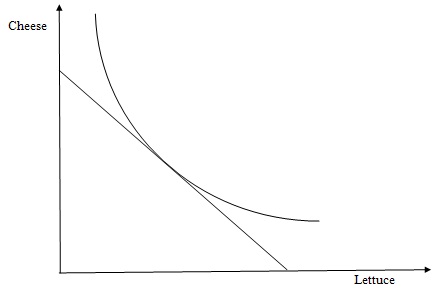
Jim a vegetarian. All he eats is lettuce and cheese. His original budget constraint and utility maximizing bundle are illustrated in the graph shown below:
1531_graaph.jpg

a. The price of lettuce falls, but we observe that Jim’s consumption of lettuce remains unchanged. Using the graph, illustratethe price change. On the graph, clearly label the old and new consumption bundles. Derive and label the income and substitution effects for lettuce. 

b. Is cheese a normal good to Jim? How do you know? If so, can you tell if it’s a luxury or a necessity? 

   Related Questions in Microeconomics

  • Q : Outcome of a purely competitive market

    When cost conditions are otherwise identical, compared to the outcome of a purely competitive market, in that case a monopolist: (w) produces less and charges more. (x) maximizes total profits whenever possible. (y) confronts a demand curve where P =

  • Q : Wage Differentials-occupational crowding

    The Disadvantaged groups have historically been pressured in the direction of low wage jobs in a process termed as: (i) Occupational crowding. (ii) Labor staggering. (iii) Systemic discrimination. (iv) Reverse favoritism. (v) Nepotism.

    Q : Saving in Negatively Investment Saving

    Saving is positively related to and investment is negatively related to: (1) marginal benefits and marginal costs. (2) real interest rates.  (3) returns onto alternatives. (4) expectations. (5) government surpluses and deficits.

    Q : Problem on quantity of Whopper Slushees

    When Adam Smith’s invisible hand executed with no government intervention, this market would be in equilibrium and quantity of Whopper Slushees demanded the quantity supplied would be equivalent at: (i) Price P1. (ii) Quantity Q1. (iii) Price P3. (iv) Quantity Q

  • Q : Demand of various vegetable why demand

    why demand change of onion in during one week due to change in it's price

  • Q : Long-run equilibrium price paid Pure

    Pure competitors in a long-run equilibrium are paid a price which: (i) allows recovery of any previous operating losses. (ii) equals MC although exceeds average cost. (iii) maximizes average revenue minus average cost. (iv) equals maximum long run ave

  • Q : Effect of an increase in the price

    Which of the following diagrams depictes(s) the effect of an increase in the price of Budweiser beer on the market for Coors beer? A) A and C. B) A only. C) B only. D) C only. 190_gh.pn</span></p>
                                        </div>
                                        <!-- /comment-box -->
                                    </li>
   
   </td>
	</tr><tr>
		<td>
       
      <li>
                                        <div class=

    Q : Automation in unionized industries Can

    Can someone please help me in finding out the accurate answer from the following question. The higher union wages would be least probable to follow: (i) Tighter immigration policies. (ii) Obligatory retirement programs. (iii) High union initiation fees. (iv) More auto

  • Q : NOT price discriminate by monopoly Into

    Into equilibrium, a monopoly which does NOT price discriminate will tend to produce: (w) the socially optimal rate of output. (x) a level of output where price exceeds marginal social cost. (y) lower output at lower prices than a competitive market. (

  • Q : Firms producing similar good Firms

    Firms which operate numerous plants that produce similar good are: (i) Vertically integrated. (ii) Generating leakages in circular flow. (iii) Proprietorships. (iv) Horizontally integrated. Can someone please help me in finding out