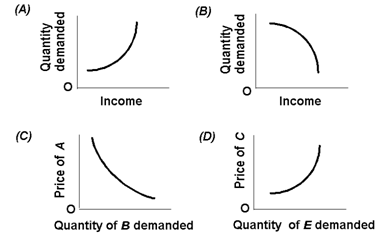
Problem on coefficient of income elasticity
Refer to the following diagrams give the answer of following question. In which case would the coefficient of income elasticity be positive? 1) A 2) B 3) C 4) D
What will be the consequence of a rise or fall in the bank rate on money supply? Answer: It will reduce or raise the money supply.
Can someone please help me in finding out the accurate answer from the following question. The Carpenter's Society of the Philadelphia: (i) Was established in the year 1924. (ii) Functioned government contracts throughout the Great Depression. (iii) Bargained for the
Pure competitors in a long-run equilibrium are paid a price which: (i) allows recovery of any previous operating losses. (ii) equals MC although exceeds average cost. (iii) maximizes average revenue minus average cost. (iv) equals maximum long run ave
The purely competitive model: (w) is characteristic of many actual U.S. market structures. (x) analyzes a type of economy which is now extinct. (y) is a helpful abstraction from actuality for analyzing firms’ behavior. (z) proves which modern ca
Financial intermediation occurs while financial institutions: (w) incur substantial outflows of funds. (x) channel flows from the ultimate lenders to the ultimate borrowers. (y) face rigid reserve requirement ratios. (z) experience "runs" when deposit
When the minimum amounts of food, clothing and shelter essential for survival absorb all of a family’s income, in that case the family is experiencing: (w) relative poverty. (x) economic shock. (y) financial destitution. (z) absolute poverty.
Within the short run, there monopolies can: (i) make economic profits. (ii) break even. (iii) make economic losses. (iv) All of the above. Hey friends please give your opinion for the problem of Economics <
If John Whittler can sell totem poles for $1,800 at all, he markets 60 yearly, but while the price falls to $600 apiece; in that case he is willing to sell only 24 yearly. His price elasticity of supply is: (w) 0.43. (x) 0.86. (y) 1.62. (z) 2.48.
A Rise in the quantity of frozen vegetarian lasagna demanded would be much probable to outcome from raises in the: (i) Cost of raw vegetables. (ii) Wages paid workers in lasagna developed plants. (iii) Number of people who perform strict vegetarianism. (iv) Costs of o
Saving is positively related to and investment is negatively related to: (1) marginal benefits and marginal costs. (2) real interest rates. (3) returns onto alternatives. (4) expectations. (5) government surpluses and deficits. Discover Q & A Leading Solution Library Avail More Than 1433759 Solved problems, classrooms assignments, textbook's solutions, for quick Downloads No hassle, Instant Access Start Discovering 18,76,764 1945702 Asked 3,689 Active Tutors 1433759 Questions Answered Start Excelling in your courses, Ask an Expert and get answers for your homework and assignments!! Submit Assignment
18,76,764
1945702 Asked
3,689
Active Tutors
1433759
Questions Answered
Start Excelling in your courses, Ask an Expert and get answers for your homework and assignments!!