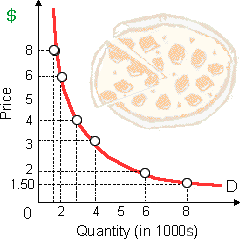
Price increment in elasticity
A price hike $4 to $5 per slice of pizza because of total revenue to: (w) fall. (x) remain constant. (y) rise. (z) this is not possible to tell from such data. How can I solve my economics problem? Please suggest me the correct answer.
A price hike $4 to $5 per slice of pizza because of total revenue to: (w) fall. (x) remain constant. (y) rise. (z) this is not possible to tell from such data.
How can I solve my economics problem? Please suggest me the correct answer.
Why economic problems occur? Answer: This is due to unlimited or infinite wants and inadequate resources.
The automakers slashed prices and gave ‘zero percent financing’ throughout the year 2001-2003 recession. An expected outcome was: (1) The decline in the demand for utilized cars. (2) enhanced maintenance of older cars by their owners. (3) Buyers purchasing
Assets turn into less desirable to prospective financial investors while: (w) they become more liquid. (x) interest rates increase. (y) their prices go up. (z) default risks decrease. How can I solve my Eco
The law of supply states that the amount of a good supplied is: (i) Legally governed by the production regulations. (ii) Inversely related to its absolute price. (iii) Recognized by the consumer tastes in the free market economy. (iv) Positively relat
Imperfect data: Most studies start with imperfect data. Few datasets involve the entire population of interest. Typically, the data has been gathered by others for specific purposes, and as such may have built in b
The union strategy made illegal through the Taft-Hartley Act of 1948 was: (1) Jurisdictional strikes centered on which the unions would symbolize a firm’s staff. (2) Contracts in which the firms agreed to preferentially encourage the union members. (3) ‘Ri
Whenever your purchasing power drops as the price of a good you purchase increases, you make adjustments as of the: (1) Marginal utility effect. (2) Price level effect. (3) Income effect. (4) Consumer excess effect. Choose the righ
Interdependent decision making through firms is most common within: (w) purely competitive industries. (x) monopolized industries. (y) oligopolies. (z) monopolistic competition. Please choose the right answer from
If Bank of America helps link an inventor in require of additional funds to develop a ground breaking invention along with a retired school teacher along with excess savings, in that case they are performing: (1) love connections. (2) financial interm
Your construction company currently bought a bulldozer on credit. By the perspective of your lender, and your firm’s IOU for this bulldozer is an illustration of: (1) a liability. (2) economic capital. (3) total variable cost. (4) capitalization. (5) financial c
18,76,764
1935132 Asked
3,689
Active Tutors
1432860
Questions Answered
Start Excelling in your courses, Ask an Expert and get answers for your homework and assignments!!