--%>

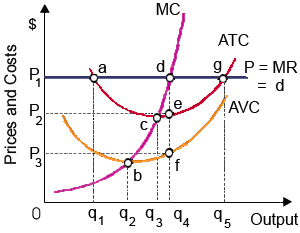
Output level of profit maximizing of competitive firm

The profit maximizing competitive firm in illustrated graph will: (i) produce output level q5. (ii) minimize total costs by producing output level q3. (iii) experience fixed costs equal to 0P3fq4. (iv) produce output level q4. (v) inevitably experience economic losses.
1858_Total Revenue1.png

How can I solve my Economics problem? Please suggest me the correct answer.

   Related Questions in Microeconomics

  • Q : Effects of Globalization on Indian

    What do you mean by globalization and its effects on the Indian economy?

  • Q : Differentiate pure competition and

    The difference among pure competition and monopolistic competition is which: (w) monopolistic competitors generate more profit in the long run. (x) monopolistic competitors always ignore short term losses. (y) long run entry and exit is probable in pu

  • Q : Estimate Gini index Computing the

    Computing the proportion of the area above a Lorenz curve although below the 45-degree reference line relative to the whole area below the reference line yields a numeric measure of inequality termed as a/an: (w) Gini index. (x) inequality coefficient

  • Q : Demanding more labor in competitive fim

    A competitive firm will demand more labor when: (1) technological advances favor automation. (2) the price of the firm's output rises. (3) more firms enter the industry. (4) the value of the marginal product is below the wage rate. (5) workers utilize

  • Q : Needs of families by poverty line

    The official “poverty line” computed by the federal government is the income level needed to meet the perceived fundamental needs of families along with differing characteristics as size, location, etc. Therefore, it is based on: (1) a rel

  • Q : Income tax rates and government

    When line 0C0' in this figure shows the current Lorenz curve for the U.S. distribution of income after taxes and transfers, the probably short run outcomes of 10 percent cuts into both income tax rates and government transfer

  • Q : Why are buyers and sellers forced to be

    Several buyers and sellers are forced to be price-takers since: (w) vigorous competition maintains individuals from noticeably influencing the market. (x) only monopoly firms adjust quantities. (y) markets adjust slowly. (z) quantity adjustment is not

  • Q : Problem on cost curve The following

    The following diagram illustrates the short-run average total cost curves for five different plant sizes of any firm. The shape of each curve reflects: 1) increasing returns, followed by diminishing returns. 2) economies of scale, followed by diseconomies of scale. 3)

  • Q : Problem on price elasticity The firm’s

    The firm’s net revenue grows whenever the price of a good is cut when the price elasticity of: (i) Demand surpass the price elasticity of supply. (ii) Replacement goods are less than one. (iii) Supply is in an associatively elastic range. (iv) D

  • Q : Increasing-cost industries average

    Within increasing-cost industries average there are: (w) production costs fall as output increases. (x) production costs rise as the number of firms in the industry grows. (y) production costs rise when the number of firms into the industry falls. (z)