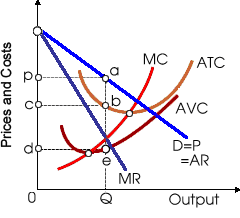
Monopolistic competitor in market
When this monopolistic competitor makes Q units: (1) P > MC. (2) MR = MC. (3) total revenue total cost is maximized. (4) MSB > MSC. (5) All of the above. Please guys help to solve this problem of Economics with some explanation.
When this monopolistic competitor makes Q units: (1) P > MC. (2) MR = MC. (3) total revenue total cost is maximized. (4) MSB > MSC. (5) All of the above.
Please guys help to solve this problem of Economics with some explanation.
Buyers' demand prices would be ____ and sellers' supply prices would be ____ when the U.S. restricted car imports to Q1. (w) P2 and P1. (x) P0 and P2. (y) P0 and P
Profit is maximized when this brickyard manufactures an output level of: (1) 6,000 generic bricks daily. (2) 7,000 generic bricks daily. (3) 15,000 generic bricks daily. (4) 17,000 generic bricks daily. (5) 20,000 generic bricks daily. Q : Occurrences of imposing tax on You regularly buy artichokes that happen to be perfectly elastically supplied within the long run. Therefore government imposes a tax upon artichokes. Then the tax is eventually borne by: (w) retailers. (x) consumers. (y) consumers and artichoke farme
You regularly buy artichokes that happen to be perfectly elastically supplied within the long run. Therefore government imposes a tax upon artichokes. Then the tax is eventually borne by: (w) retailers. (x) consumers. (y) consumers and artichoke farme
When a price hike for regular gas from $2.00 to $2.20 reduces quantity demanded from 20 million gallons to 19 million gallons daily, and an raise in the price of premium gas from $3.00 to $3.20 decreases its quantity demanded daily from 20 million gal
Joint profit maximization is least compatible along with the behavior of: (w) General Motors’ division in Chevrolet, Cadillac, Hummer, Delco Remy and Frigidaire, etc. (x) a successful cartel as like OPEC. (y) a collusive agreement leading to sha
Of the given price elasticities for market supply curves or market demand curves, and the one which is absolutely inconsistent along with standard economic theory would be one for that, across feasible ranges of prices as: (i) supply
Describe why is the budget line slope downward?
Rising economic profits within a competitive market do NOT produce pressures for: (i) expansions of existing firms. (ii) entry by new firms. (iii) price hikes. (iv) increases in costs for specialized resources. (v) ultimate erosion of
Government regulation intends at certain potentially competitive prices or transactions frequently induce private adjustments through firms and individual therefore unexpected results comprise: (w) increased rates of growth of tax revenues. (x) rapid
From 1950, the pre-tax and pre transfer income distribution comprises: (w) become more equitably distributed. (x) remained about constant. (y) become less equitably distributed. (z) moderated because the rich and the poor both lost income to the middl
18,76,764
1921931 Asked
3,689
Active Tutors
1433123
Questions Answered
Start Excelling in your courses, Ask an Expert and get answers for your homework and assignments!!