--%>

Monopolistic competitive firm in normal accounting profits

This monopolistically competitive firm in illustrated figure produces Q units as well as experiences: (1) economic profits equal to 0cbQ. (2) economic losses equal to cpab. (3) more than normal accounting profits. (4) marginal cost in excess of average total cost. (5) total revenue less than total cost.
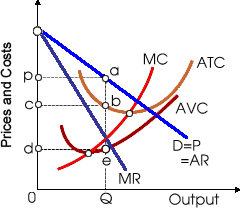
971_Monopolistic Competition.png

Hey friends please give your opinion for the problem of Economics that is given above.

   Related Questions in Microeconomics

  • Q : Sharing the characteristics of purely

    Purely competitive markets share the feature of: (i) collusive behavior among of large firms. (ii) freedom of entry and exit in the long run. (iii) extensive negotiations about prices in between buyers and sellers. (iv) widespread product differentiat

  • Q : Increases profit of a firm when output

    A firm would raise profits when it: (w) decreased output when MR > MC. (x) expanded output while MR > MC. (y) increased output when MC > MR. (z) shut down since MR = MC. Hello guys I want your advice. Plea

  • Q : Taxes on pure land rent Taxes on pure

    Taxes on pure land rents: (1) especially distort economic behavior. (2) are forward shifted to consumers. (3) transfer income from the public treasury to private landowners. (4) are allocatively neutral relative to most alternative taxes. (5) are over

  • Q : Pure competition and monopolistic

    Pure competition and monopolistic competition are: (1) polar opposites on the continuum of market structures. (2) the two market structures in that firms are pure quantity adjusters. (3) both characterized by an absence of barriers to long run entry a

  • Q : Problem on bonds and interest rate The

    The _______ price for a lately issued bond signifies that the firm issuing the bond is paying the _______ interest rate to borrow the funds. (1) Lower; lower. (2) Lower; higher. (3) Higher; higher. (4) None of the above. The interest rate is fixed.

    Q : Legal barriers to entry in a market

    Governmentally-imposed obstacles to the entrance of new firms within a market are termed as: (1) regulatory barriers or legal barriers to entry. (2) strategic barriers to entry. (3) natural barriers to entry. (4) tax barriers to entry. (5) revenue blockades.

  • Q : Analytic time of corn harvest The

    The period after one corn harvest is done and before the subsequent corn harvest begins is the: (1) short-run. (2) intermediate period. (3) long-run. (4) market period. (5) fiscal year for budgeting. Can someone explain/help me wit

  • Q : Long Run-Firm can vary all inputs I

    I have a problem in economics on Long Run-Firm can vary all inputs. Please help me in the following question. In long run: (1) Firm can vary all the inputs. (2) Firm can vary few inputs, however not all. (3) Capital starts to depreciate. (4) Output increases.

  • Q : Saving and the Supply by Interest Rate

    When the preference for current consumption over future consumption strengthens, in that case the: (w) interest rate rises. (x) interest rate falls. (y) present value of future income rises. (z) interest rate remains the same. How

  • Q : Wage of firm elasticity of demand for

    A firm’s wage elasticity of demand for labor is least influenced by: (1) how much time the firm has to adjust to changing wages. (2) the proportion of labor’s share of the total costs.  (3) the ease of substitution in between capital