--%>

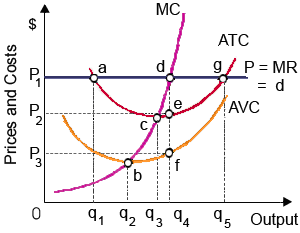
Maximum economic profits in purely competitive firm

For this purely competitive firm, area P2P1de shows: (1) fixed cost (TFC). (2) losses, but the minimum possible economic loss. (3) average fixed cost (AFC). (4) maximum economic profits. (5) the rate of return on investment.
2102_Total Revenue1.png

Can anybody suggest me the proper explanation for given problem regarding Economics generally?

   Related Questions in Microeconomics

  • Q : Managerial slack or X-inefficiency

    X-inefficiency (also termed as managerial slack): (1) tends to drive up fixed costs. (2) commonly results from firms not being hard pressed through competitors. (3) can absorb much of a monopoly’s potential profit. (4) is a prob

  • Q : Freedom to enter or leave the market in

    Purely competitive industries are not described by: (i) numerous potential buyers. (ii) product homogeneity. (iii) numerous potential sellers. (iv) freedom to enter or leave the market within the short run. (v) power to adjust quantities although no p

  • Q : Wage Differentials I have a problem in

    I have a problem in economics on Wage Differentials. Please help me in the following question. The major determinants of the wage differentials comprise: (1) General human capital needs. (2) Working conditions. (3) Occupational crowding (4) Specific h

  • Q : Monopsonistic Exploitation-MRP and w

    Can someone please help me in finding out the accurate answer from the following question. In the equilibrium for an organization with power to adjust the wage it pays, the rate of monopsonistic exploitation equivalents any differe

  • Q : Discrimination and Income Differentials

    By 2000, the differential among the rich and the poor which can be attributed to economic discrimination was computed at: (w) approximately 60 percent. (x) approximately 30 percent. (y) under 10 percent. (z) zero.

  • Q : The Debate about Welfare Programs

    Debate over U.S. welfare programs doesn’t focus onto: (w) choices in amounts and types of subsidies for health care. (x) repealing the negative income tax. (y) impacts on efficiency and incentives. (z) social conflicts over redistribution of inc

  • Q : Price crosses elasticity of demand for

    When each 1 percent hike in the price of pencils causes a 2 percent decline within the quantity of erasers sold, the price crosses elasticity of demand for such complementary goods is about: (1) -2.0. (2) -1.0. (3) -4.0. (4) 2.0. (5) 1.0.

  • Q : Problem Regarding to Contestable Markets

    Even though the concentration ratio for an oligopoly is close to hundred, firms may operate rather efficiently when the market: (1) price conforms to a limit pricing model. (2) is contestable since entry and exit are easy. (3) demand curve is unitaril

  • Q : Labor markets gain maximization When,

    When, after hiring the very last worker, the organization’s profit is similar as it was before the last worker was hired, then the firm must: (p) Hire more workers to raise the profit. (q) Layoff some workers to raise the profit. (r) Not appoint any more workers

  • Q : Marginal Productivity Theory of Income

    The income distribution into a market economy is primarily found by differences within: (1) effort and sacrifice alone. (2) resource ownership and resource prices. (3) birth and social standing. (4) Lorenz coefficients. (5) political