--%>

Maximizes profit in production of product

When Robomatic Corporation maximizes profit in its production of RoboMaids, its monthly total revenue will be roughly: (i) $100 million. (ii) $140 million. (iii) $160 million. (iv) $200 million. (v) $240 million.
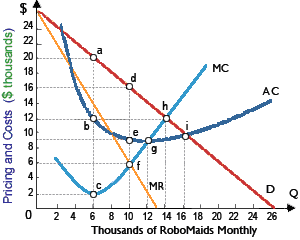
1895_Elasticity and profit.png

Can anybody suggest me the proper explanation for given problem regarding Economics generally?

   Related Questions in Microeconomics

  • Q : Labor Unions and Aggregate salary Income

    The least probable outcome when unions succeed in increasing their member’s salaries is that: (1) Wages in non-union sectors will drop. (2) Employment will produce in non-union sectors. (3) Barriers will be building up to limit the entry to unions. (4) Labor's s

  • Q : Unionized construction workers The

    The passage of a considerably higher legal minimum wage would be most probable to advantage: (1) Philosophy majors. (2) American high-school drop-outs in their teens. (3) Foreign workers whose manufacture is exported to the United States. (4) Unionized construction wo

  • Q : Break-even levels of output for a firm

    Break-even levels of output for a firm happen where is: (w) total revenue equals total economic cost. (x) accounting profits are zero. (y) total variable cost equals total fixed costs. (z) competitive firms will shut down within the short run.

  • Q : Market demands in short run Can someone

    Can someone please help me in finding out the accurate answer from the following question. In short run, the market demands are: (1) Stimulated if resource costs increase. (2) Simply estimated employing aggregate data. (3) Positively associated to the

  • Q : Blacklisting-Labor history Can someone

    Can someone please help me in finding out the accurate answer from the following question. Firms which colluded by circulating the names of the union organizers and hence they would have difficulty getting jobs were engaged in a now-illegal practice termed as: (1) Fea

  • Q : Exploitation-Competitive Markets The

    The removal of exploitation of the labor wage payments beneath the value to society of each and every individual worker’s productive contribution is automatic when business decision makers: (i) Should set wages via collective bargaining agreements with the labor

  • Q : Find price elasticity of demand for

    Suppose yearly steel sales double to 80 million tons while the price falls $40 per ton, to $180 per ton. Therefore price elasticity of demand for steel is approximately: (w) 3.333. (x) 10.000. (y) 2.500. (z) 6.667.

    Q : Positively sloped resource supply curves

    When the resource supply curves of facing a competitive industry are positively sloped, in that case the exit of firms which have incurred losses will result within: (w) higher prices and lower output by each firm, and higher average production costs.

  • Q : Shifting of Complementary Goods towards

    The War in Iraq contributed to sharp rises in the world price of oil. This is most probable to encompass caused the demand for car washes in United States to: (1) Shift towards right. (2) Increase vertically. (3) Stabilize. (4) Shift towards left. (5) Much more inform

  • Q : Elimination of exploitation The removal

    The removal of exploitation of labor [that is, wage payments beneath the value to society of each and every individual worker’s productive contribution] is automatic when business decision makers: (1) Should set wages via collective bargaining agreements with th