--%>

Maximize profit by marginal revenue and costs

Prohibition Corporation’s very famous St. Valentine’s Day software is going within version 6. The very first point Prohibition requires to classify in its quest to maximize profit is the: (1) point e. (2) point f. (3) point g. (4) point h. (5) point i.
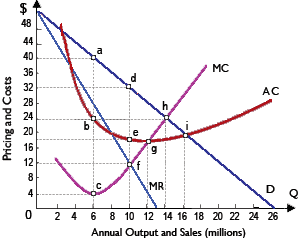
1999_software of Elasticity.png

Hey friends please give your opinion for the problem of Economics that is given above.

   Related Questions in Microeconomics

  • Q : Infinite price elasticity of supply The

    The price elasticity of supply in given grph is infinite therefore supply is perfectly price elastic within: (w) Panel A. (x) Panel B. (y) Panel C. (z) Panel D.

    Q : Influence of short run supply In short

    In short run, the supply of Pinot Noir from the viewpoints of oenophiles who fancy it would be influenced least by: (i) The offspring of late baby boomers arriving the legal age to buy alcohol. (ii) Imposition of a maximum tax for each and every bottle of wine generat

  • Q : Characteristic of pure competition A

    A purely competitive firm: (w) is a price taker. (x) is a price maker. (y) is a large part of the industry. (z) sells a differentiated product. Hello guys I want your advice. Please recommend some views for above <

  • Q : Demanding more labor in competitive fim

    A competitive firm will demand more labor when: (1) technological advances favor automation. (2) the price of the firm's output rises. (3) more firms enter the industry. (4) the value of the marginal product is below the wage rate. (5) workers utilize

  • Q : Tacit collusion by oligopolists Tacit

    Tacit collusion through oligopolists is possible when: (w) agreed to by the government. (x) a price leader is visible. (y) the oligopolists succeed in forming a cartel. (z) very few firms control the market. How ca

  • Q : Average total costs above the demand

    A profit-maximizing monopolist will necessarily incur economic losses when, at every feasible level of output as: (w) average fixed costs [AFC] are very high. (x) average total costs [ATC] lies above the demand curve. (y) average tota

  • Q : Problem of asymmetric information

    Provide the solution of this question. The problem of asymmetric information is that: A) neither health care buyers nor providers are well-informed. B) health care providers are well-informed, but buyers are not. C) the outcomes of many complex medical procedures cann

  • Q : NOT price discriminate by monopoly Into

    Into equilibrium, a monopoly which does NOT price discriminate will tend to produce: (w) the socially optimal rate of output. (x) a level of output where price exceeds marginal social cost. (y) lower output at lower prices than a competitive market. (

  • Q : Marginal Productivity Theory of Income

    The income distribution into a market economy is primarily found by differences within: (1) effort and sacrifice alone. (2) resource ownership and resource prices. (3) birth and social standing. (4) Lorenz coefficients. (5) political

  • Q : Demand rises for relatively price

    Alyssa’s Floral Shoppe dropped its prices for a dozen roses by $45 to $35 this annum. Due to this decrease into price, the quantity sold increased from 1000 to 1500. The demand for Alyssa’s rises is: (1) perfectly price elastic. (2) relati