--%>

Market price of long-run equilibrium

When this firm is typical in this purely competitive market, in that case long-run equilibrium for Christmas trees will be reached at a market price is of: (1) P1. (2) P2. (3) P3. (4) P4. (5) Not computable from these figures.
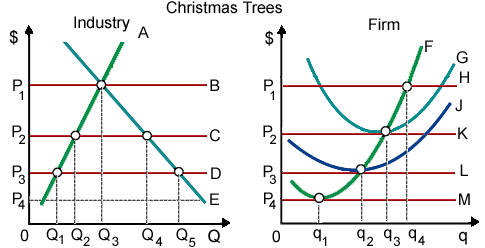
1638_supply and demand1.png

Please choose the right answer from above...I want your suggestion for the same.

   Related Questions in Microeconomics

  • Q : Firms in industry change When the firms

    When the firms are earning abnormal gains, how will the number of firms in industry change? Answer: The number of firms in industry will tend to rise.

  • Q : Problem of Nash Equilibrium Carlos and

    Carlos and Ivana are room-mates and friends. Carlos and Ivana eat together despite who cooks on a given night. Within this payoff matrix, Nash equilibrium could never be obtained in that: (w) neither Carlos nor Ivana cook, nor do they eat. (x) Carlos

  • Q : Ultimate lenders and borrowers

    Financial intermediation is a process wherein financial institutions: (w) incur substantial outflows of funds. (x) facilitate financial flows by eventual lenders to eventual borrowers. (y) face rigid reserve requirement ratios. (z) experience "runs" w

  • Q : Consequence of successful product

    Maggie thinks there are main differences among Crest, Colgate, Aquafresh and Rembrandt toothpastes, and eventually chooses Crest. Therefore her perception is mainly a consequence of: (1) successful product differentiation. (2) monopolistic competition. (3) informative

  • Q : Individual firm in purely competitive

    In a purely competitive industry, the individual firm: (i) can raise the quantity demanded by lowering the price of its product. (ii) experiences substantial economies of scale. (iii) faces a completely inelastic demand curve. (iv) cannot influence th

  • Q : Monopolistic competition in long run

    When this firm initially had important market power along with potential long-run economic profit, a likely cause of the firm finally being in a stable equilibrium of an $18 price and output of 5,000 units every day would be:  (1

  • Q : Restricting output below competitive

    Below the competitive equilibrium output, restricting output will: (w) raise price above the competitive equilibrium price. (x) raise price above the marginal cost of the last unit produced. (y) generate a deadweight efficiency loss from underproducti

  • Q : Normative Standards for Distribution

    Relative to a requirements standard for distributing income, in that case the adoption of an equality standard would most likely tend to be: (w) unarguably fairer. (x) less bureaucratic. (y) more harmful to work incentives. (z) clearly less fair.

  • Q : Profit Maximization in Labor Markets

    Can someone help me in finding out the right answer from the given options. All the profit maximizing firms use labor up to the point where: (1) VMP = MFC. (2) VMP = w. (3) VMP = MRP. (4) MRP = MFC. (5) MR   MC is maximized.

  • Q : Demand curves rightward of potential

    Monopolistically competitive firms advertise in try to shift their: (1) own supply curves leftward. (2) competitors' costs upward. (3) existing customers' demand curves leftward. (4) tax burdens to resource suppliers. (5) potential customers' demand c