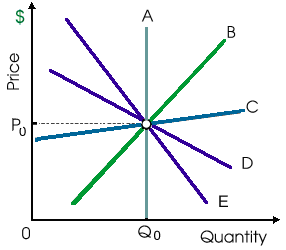
Market-period supply curve
For a purely competitive industry a market-period supply curve would be: (i) curve A. (ii) curve B. (iii) curve C. (iv) curve D. (v) curve E. Hello guys I want your advice. Please recommend some views for above Economics problems.
For a purely competitive industry a market-period supply curve would be: (i) curve A. (ii) curve B. (iii) curve C. (iv) curve D. (v) curve E.
Hello guys I want your advice. Please recommend some views for above Economics problems.
Drive-by shootings by that several groups of beer or liquor distributors or producer attempted to liquidate rival groups largely finished while the: (w) U.S. Constitution was ratified and Whiskey Rebellion which began into 1794 finally finished. (x) 21st amendment to
The price elasticity of demand would possibly be lowest for: (1) Dasani. (2) Deer Park. (3) Aquafina. (4) bottled water. (5) Perrier. Can anybody suggest me the proper explanation for given problem regarding
I have a problem in economics on Economic concept of total costs. Please help me in the following question. The economic concept of total costs and the bookkeeper’s concept of net costs differ as economists: (1) Place a lower value on the psychi
Can someone please help me in finding out the accurate answer from the following question. The profit-maximizing firm which is perfectly competitive in the resource market however which has the market power in output market will hire labor at a point where: (1) VMP =
The Caveat venditor is an ancient legal doctrine which, when the products are defective or fraudulently symbolized, imposes legal liabilities on: (1) Seller of the good. (2) Government, for failing to save consumers. (3) Resource owner. (4) Buyer, for failing to use d
Equilibrium interest rates on different financial securities tend to be negatively associated to: (1) the time remaining until an asset matures. (2) default, exchange rate, and interest rate riskiness of an asset. (3) liquidity. (4) savers’ time
The demand curves for most of the nondurable consumer goods would be least influenced by modifications in: (i) Interest rates. (ii) House-hold income. (iii) Prices for related goods. (iv) Tastes and preferences. Ca
Provide the solution of this question. The problem of asymmetric information is that: A) neither health care buyers nor providers are well-informed. B) health care providers are well-informed, but buyers are not. C) the outcomes of many complex medical procedures cann
A price hike $4 to $5 per slice of pizza because of total revenue to: (w) fall. (x) remain constant. (y) rise. (z) this is not possible to tell from such data. Q : Economies of Scope-Firms using Firms which use similar production facility or groups of inputs to concurrently generate various kinds of products are taking benefit of: (1) Tax loop-holes. (2) Variegated production. (3) Economies of scope. (4) Economies of scale. (5) Monopoly power. Discover Q & A Leading Solution Library Avail More Than 1453183 Solved problems, classrooms assignments, textbook's solutions, for quick Downloads No hassle, Instant Access Start Discovering 18,76,764 1957971 Asked 3,689 Active Tutors 1453183 Questions Answered Start Excelling in your courses, Ask an Expert and get answers for your homework and assignments!! Submit Assignment
Firms which use similar production facility or groups of inputs to concurrently generate various kinds of products are taking benefit of: (1) Tax loop-holes. (2) Variegated production. (3) Economies of scope. (4) Economies of scale. (5) Monopoly power. Discover Q & A Leading Solution Library Avail More Than 1453183 Solved problems, classrooms assignments, textbook's solutions, for quick Downloads No hassle, Instant Access Start Discovering 18,76,764 1957971 Asked 3,689 Active Tutors 1453183 Questions Answered Start Excelling in your courses, Ask an Expert and get answers for your homework and assignments!! Submit Assignment
18,76,764
1957971 Asked
3,689
Active Tutors
1453183
Questions Answered
Start Excelling in your courses, Ask an Expert and get answers for your homework and assignments!!