--%>

Market in equilibrium point by interest rate

When this market is primarily in equilibrium at point c, any drop within interest rates caused through an increase in people’s willingness to save will cause as: (1) the rate of return schedule reflected into I0 to shift to the right. (2) the rate of return schedule reflected into I0 to shift to the left. (3) a movement down the rate of return schedule by point c to point e. (4) a movement up the rate of return schedule from point c to point a. (5) households to raise their saving.
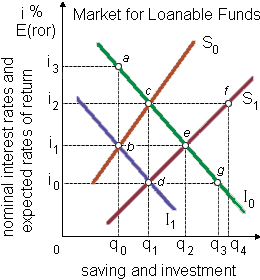
1987_Problem on Loanable Funds.png

Hello guys I want your advice. Please recommend some views for above Economics problems.

   Related Questions in Microeconomics

  • Q : Monopolistic Exploitation dilemma In

    In equilibrium for the price maker firm, the rate of monopolistic exploitation is the difference between: (p) P and MR. (q) P and MC. (iii) Total revenue and net cost per unit of output. (r) Output price and rate of monopsonistic exploitation. (s) VMP and MRP.

  • Q : Zero or negative marginal utility of a

    Whenever the marginal utility of a good becomes negative or zero: (i) Goods are transformed to the bads. (ii) Net utility reaches the maximum and then declines. (iii) The maximum total advantages have been squeezed from good. (iv) People are unwilling

  • Q : Market power and inefficiency The

    The widespread and unregulated exercise of monopoly power is probable to result within: (1) economic inefficiency because price exceeds marginal cost. (2) the value of national income being higher than under competition. (3) a politically more accepta

  • Q : Reliablity with standard economic

    Which of the given behaviors is least reliable with standard economic suppositions regarding consumer behavior? (i) Gustav cannot decide which of three distinct combinations of goods he favors. (ii) Lynn hates pickled herring; however Chris is willing

  • Q : Determine total revenue by quantity and

    In this demonstrated figure, the total revenue: (w) varies inversely along with price in range b. (x) is minimized at the midpoint of the demand curve. (y) remains unchanged like price changes within range b. (z) will raise as price falls within range

  • Q : Economic profit generating purely

    In this illustrated figure in below the only purely competitive firm currently generating economic profit is in: (w) Firm A. (x) Firm B. (y) Firm C. (z) Firm D.

    Q : Problem on demand of rising exports

    Meager Russian grain harvests during the year 2001 led to increasing exports of U.S. grain to Russia, that symbolized a raise in the: (1) Demand for Russian grain. (2) Supply of U.S. grain. (3) Supply of Russian grain. (4) Demand for the U.S. grain.

    Q : Calculating accounting profits The firm

    The firm has $70,000 in implicit costs, and the economic profit of $40,000. This firm’s: (i) Explicit cost equivalent $30,000. (ii) Accounting profits equivalent $110,000. (iii) Normal gain equivalents $40,000. (iv) Explicit costs equivalent $110,000.

  • Q : Corporate Taxes-Disadvantages of a

    One of the major disadvantages of the corporation is: (i) Double taxation of its gains. (ii) Its incapability to outlive the death of an owner. (iii) Its unlimited liability. (iv) Its inability to increase the financial resources.

  • Q : Various kinds of capital goods Supply

    Supply curves for different kinds of capital goods are usually: (w) perfectly elastic. (x) perfectly inelastic. (y) upward sloping. (z) downward sloping. Can anybody suggest me the proper explanati