--%>

Marginal social costs exceed the marginal social benefits

When governments compelled pharmaceutical producers to manufacture and sell at least Q3 penicillin, in that case the: (1) purely-competitive firms which produced penicillin would experience persistent economic profits. (2) resulting inadequate antibiotic treatments would leave much disease untreated. (3) marginal social benefits of penicillin would exceed the marginal social costs. (4) loss in social welfare would about equal the area of triangle adf. (5) marginal social costs of penicillin would exceed the marginal social benefits.
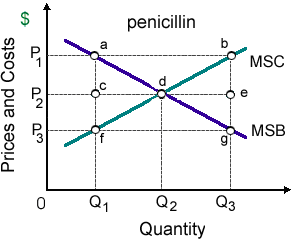
1856_Efficiency and Welfare.png

Hey friends please give your opinion for the problem of Economics that is given above.

   Related Questions in Microeconomics

  • Q : Negatively-sloped-Law of Demand The

    The Demand curves are negatively-sloped mainly as people: (1) Encounter advertising which molds the product images. (2) Have less purchasing power if prices fall for the things they sell. (3) Use goods which rise in price less, and expand the utilizat

  • Q : History of labor-Yellow Dog Contracts

    The agreements not to join unions were once general needs for employment. Now outlawed, such are termed as: (1) Blacklist contracts. (2) Feather-bedding certificates. (3) Employment screens. (4) Exclusionary provisions. (5) Yellow dog contracts.

    Q : Long run equilibrium for purely

    When a purely competitive industry is into long run equilibrium, in that case for the typical firm: (a) P = FC = TC = MC = MR = AR = AC. (b) P = AR = MR = SRMC = SRAC = LRMC = LRAC. (c) pure economic profits reward especially effectiv

  • Q : Equal distributions of income or wealth

    Perfectly equal distributions of income or wealth are reflected within the Lorenz curve demonstrated as: (i) line 0A0'. (ii) line 0B0'. (iii) line 0C0'. (iv) line 0D0'. (v) line 0E0'.

    Q : Problem regarding Principal Agent The

    The baseball manager, whose players decline to bunt occasionally, rather always swinging for the homeruns, faces a: (i) Second-mover drawback. (ii) Prisoner’s dilemma. (iii) Principal-agent problem. (iv) Grim strategy. Can so

  • Q : Existence of elasticity from zero to

    Each negatively sloped linear demand curve consists of: (1) variable slope. (2) price elasticity coefficients which increase when the price falls. (3) price elasticity which range from zero to infinity. (4) a price elasticity of one at whole points. (5) an inelastic region above

  • Q : Negatively relative interest rate

    Interest rates tend to be negatively associated to: (w) household preferences for more liquid assets. (x) typical rates of return on alternative investments. (y) household willingness to delay consumption. (z) investor optimism concerning rates of ret

  • Q : Measurement of cross-elasticity of

    The cross-elasticity of demand measures as: (1) the changes in quantities sold when the price of related good changes. (2) changes within the prices of substitute goods. (3) changes within the prices of complementary goods. (4) how quantities sold cha

  • Q : Exceeds marginal revenue curve by

    That this firm can’t successfully price discriminate is most strongly indicated through the fact that: (1) the linear demand curve exceeds the marginal revenue curve for all outputs shown. (2) MR = MC maximizes profit. (3) total revenue total co

  • Q : Opponents of the current welfare system

    Opponents of the current welfare system who desire the welfare system scaled down tend to argue which this: (1) has constantly experienced funding cuts for the past decade. (2) cannot succeed in helping poor people within a market economy. (3) stimula