--%>

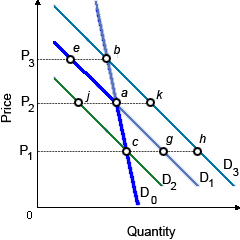
Kinked Demand by decreasing price

In this kinked demand curve model as in given graph, when this firm operated at point a and lowered its price by P2 to P1 and other firms in the industry also lower prices, in that case this firm will move from point a to: (w) point g.  (x) point c. (y) point h. (z) point j.
212_Kinked Demand Curves.png

Please choose the right answer from above...I want your suggestion for the same.

   Related Questions in Microeconomics

  • Q : Problem regarding marginal factor cost

    In equilibrium for any of profit-maximizing firm, marginal revenue product of the labor: (i) Is equivalent to the change in net revenue related with selling an extra unit of output. (ii) Surpasses the wage rate by maximum possible. (iii) Equivalents marginal factor co

  • Q : Economic profits with average total

    A monopolist can produce economic profits while: (w) average fixed costs [AFC] are very high. (x) average total costs [ATC] lies above the demand curve. (y) at least some portion of the average total costs [ATC] curve lies below the d

  • Q : How is Economic policy more scientific

    Which of the given LEAST describes the widespread but erroneous view which economists seldom agree: (1) The media focuses upon controversy, not agreement. (2) Political considerations, more than economic logic, find out policies. (3) Some economists may feel obligated

  • Q : Illustration of monopolistic competition

    A small neighbourhood grocer in a big town mainly close approximates a: (i) pure competitor. (ii) monopolist. (iii) monopolistic competitor. (iv) oligopolist. (v) monogamist. Hello guys I want your advice. Please recommend some vie

  • Q : Collective bargaining agreements Tell

    Tell me the answer of this question. Collective bargaining agreements cover: A) wages and hours. B) union status. C) seniority and job opportunities. D) all of the above.

  • Q : Resource demands from purely

    Relative to the resource demands from purely competitive sellers, demands through imperfectly competitive firms for resources tend to: (1) Perfectly price elastic. (2) Upward sloping. (3) Backward bending. (4) Less price elastic. (5) Perfectly price inelastic.

  • Q : Evidence of Diminishing Marginal Utility

    Can someone help me in finding out the right answer from the given options. The law of diminishing marginal utility might be evidenced by the person: (i) Smoking more however enjoying each and every extra cigarette less. (ii) Buying a latest car after

  • Q : Reduced effectiveness by pressure The

    The increased pace of globalization and the steady development of worldwide demands for petroleum-based products from 2002 have tended to decrease the: (w) derived demand for petroleum. (x) prices of gasoline and electricity. (y) pressures which had reduced OPEC's eff

  • Q : Definition of Consumer Surplus The

    The difference among the price a consumer would have been eager to pay for the commodity and the price consumer really has to pay is termed as: (i) Gain. (ii) The substitution effect. (iii) The income effect. (iv) Consumer surplus.

  • Q : Implication of perfect knowledge

    Describe the implication of perfect knowledge regarding market beneath perfect competition.