--%>

Inconsistent of demand with standard consumer theory

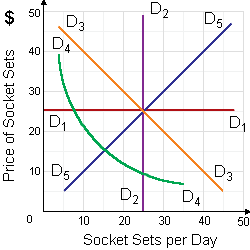
The curve which is so inconsistent along with standard consumer theory which is based only on the substitution result, this could not possibly be a demand curve for any standard kind of consumer good is: (1) curve D1D1. (2) curve D2D2.  (3) curve D3D3. (4) curve D4D4. (5) curve D5D5.
1948_Price Elasticity of Demand.png

Please choose the right answer from above...I want your suggestion for the same.

   Related Questions in Microeconomics

  • Q : Variable costs in short run A monopoly

    A monopoly tends to shut down within the short-run when: (i) price is less than the minimum of average total costs [ATC]. (ii) price cannot cover all overhead costs. (iii) variable costs are not covered. (iv) total costs exceed total revenues. (v) the

  • Q : Relative profitability and efficiencies

    From around 1890 until 1970 year, the “structure-conduct-performance paradigm” dominated theories concerning how firms behave in various types of markets. Here the word “performance” in this context consider to things as: (i) d

  • Q : Size Distribution of Income The degree

    The degree of inequality of income in between households and individuals is the: (w) marginal productivity theory of income distribution. (x) functional distribution of income. (y) distribution of wealth. (z) size distribution of income.

  • Q : Competitive advertising as waste of

    Economists have conventionally concluded which, from the vantage point of society as an entire, competitive advertising in that case: (1) enables consumers to make more efficient economic choices. (2) is a waste of resources. (3) cons

  • Q : Setting price and produces an output

    Assume that Babble-On’s patents for speech-translation software covering 314 languages lapsed, as well as entry of new competitors within this market eroded the demand for Babble-On software, but the firm retains several market powers since competitors’ pr

  • Q : Buying low price-riskless selling at

    Buying low within one market and riskless selling at a higher price into another is termed as: (1) speculation. (2) arbitrage. (3) capitalization. (4) marketeering. (5) profiteering. Please choose the right answer from above...I wa

  • Q : Relationship between MPS and multiplier

    Relationship between MPS and multiplier:K=1/1-MPC = 1/MPS or inverse relationship between MPS and the size of multiplier.

  • Q : Consuming a grouping of goods problem A

    A household utmost it’s utility by consuming a grouping of goods which exhausts income when, for each and every good, the: (i) Marginal utilities are equivalent. (ii) Prices are equivalent. (iii) Ratios of marginal utility or price are equivalen

  • Q : Problem on Budget constraints James and

    James and Louisa each have an income of $30, which they each spend on tomatoes and all other goods.  They buy tomatoes at their local farmers market, which charges $3 per pound.  Define the units for all other goods so that their price is $1 per unit. 

  • Q : Monopsonist-Wage discriminate Compared

    Compared with the price taker in labor market, the monopsonist which can’t wage discriminate will: (i) Hire more labor at any specified wage. (ii) Hire less labor at any wage. (iii) Pay a higher wage for any specified quantity of labor. (iv) Hire more prolific l