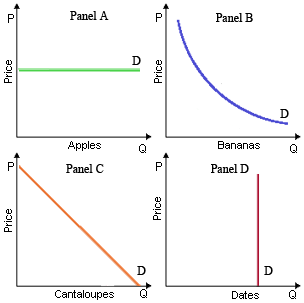
Illustration of perfectly price elastic demand curve
A demand curve which is perfectly price elastic is demonstrated into: (w) Panel A. (x) Panel B. (y) Panel C. (z) Panel D. How can I solve my Economics problem? Please suggest me the correct answer.
A demand curve which is perfectly price elastic is demonstrated into: (w) Panel A. (x) Panel B. (y) Panel C. (z) Panel D.
How can I solve my Economics problem? Please suggest me the correct answer.
The greatest percentage rate of return would be generated through a financial investment which yielded: (w) annual income = $1,000; current price = $10,000. (x) monthly income = $100; current price = $24,000. (y) annual income = $1,200; current price = $10,800. (z) an
I have a problem in economics on Formula for the marginal utility. Please help me in the following question. The formula for marginal utility of good X is as: (1) MU = change in U/ change in X. (2) MU = U/X. (3) MU = U1 U2. (4) MU = change in X/change in U.
A purely competitive firm will produce where is: (w) MC is rising. (x) MC = P. (y) MC = MR. (z) All of the above. Can anybody suggest me the proper explanation for given problem regarding Economics
Price discrimination occurs when a good is: (1) priced by a formula yielding monopoly profit. (2) denied to customers who refuse to pay the going price. (3) sold at different prices not reflecting differences in costs. (4) subject to government price
The Taft-Hartley Act prohibited strikes against the firm over the issue of which of two or more competing unions would symbolize the firm’s employees. These strikes are termed as: (i) Jurisdictional strikes. (ii) Strategic representation strikes
A city government trying to pass an excise tax for that the economic burden would be borne strictly through the seller will succeed when this imposes a tax on a good for that the price elasticity of: (i) demand is unitarily elastic. (
Since longer time intervals are considered, then demands and supplies of most of the goods become: (i) Increasingly independent. (ii) Less subject to the adjustments through buyers and sellers. (iii) Flatter (that is, quantities adjust more fully to p
The firm with monopsony power in labor market: (1) Can hire any significant amount of labor devoid of affecting the wage. (2) Can pay any wage it wishes. (3) Must pay a higher wage when it hires more labor. (4) Must pay a lower wage when it hires more
A competitive firm will demand more labor when: (1) technological advances favor automation. (2) the price of the firm's output rises. (3) more firms enter the industry. (4) the value of the marginal product is below the wage rate. (5) workers utilize
The cross-elasticity of demand among any pair of goods is positive when the goods are: (i) luxuries. (ii) necessities. (iii) complements. (iv) substitutes. Hey friends please give your opinion for the problem of
18,76,764
1922863 Asked
3,689
Active Tutors
1434771
Questions Answered
Start Excelling in your courses, Ask an Expert and get answers for your homework and assignments!!