--%>

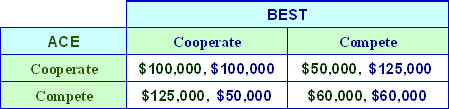
Illustration of a prisoner’s dilemma game

ACE and BEST are the only two grocery stores within a remote small town in North Dakota. There owners as each other very small, and trust each other even less. When they cooperate the Antitrust Division of the U.S. Department of Justice will never identify. That payoff matrix: (w) advises that the grocers maximize their joint profits while each follows a dominant strategy. (x) contains no clearly dominant strategy. (y) is an illustration of a prisoner’s dilemma game. (z) indicates that each grocer will make $125,000 annually by pursuing a dominant strategy.
960_Prisoners Dilemma1.png

Can anybody suggest me the proper explanation for given problem regarding Economics generally?

   Related Questions in Game Theory

  • Q : Illustration of Nash equilibrium As per

    As per this payoff matrix in demonstrated figure, Alyssa going to the football game when Ben attended the play cannot be Nash equilibrium since: (w) they’d each gain the most possible when Ben watched football when Alyssa went to the play. (x) b

  • Q : Dominant strategies ACE and BEST are

    ACE and BEST are the only two grocery stores into a remote small town within North Dakota. The owners as each other very small, and trust each other even less. When they cooperate the Antitrust Division of the U.S. Department of Justice will never know. Specified this

  • Q : Restriction for illustration of

    Illustration of negative sum games would not comprise: (i) violent carjackings. (ii) “winner-take-all” poker games. (iii) war. (iv) retaliatory barriers to international trade. (v) family feuds. Hey fri

  • Q : Game Theory and Strategic Behavior Game

    Game theory focuses upon: (w) professional athletics. (x) strategic behavior among rivals. (y) competition among board game designers. (z) economic interpretations of political behavior. Hello guys I want your advi

  • Q : Gain by implementing a first decision A

    A firm which can gain by implementing a first decision before any other firms act has a: (w) predatory pricing strategy. (x) controlling market share. (y) first mover advantage. (z) dominance strategy. Hey friends please give your

  • Q : NO net incentives to change current

    Rivals with no net incentives to modify their current strategies within a repeating sequence of games have arrived at a location of: (1) Nash equilibrium. (2) static churn. (3) classical steady state. (4) the invisible hand. (5) tactical impasse.

  • Q : Illustration of a Zero-Sum Game An

    An illustration of a zero-sum game is: (w) a baseball game. (bx) a mugging. (y) a cartel. (z) the prisoner's dilemma. Can anybody suggest me the proper explanation for given problem regarding Economics

  • Q : Explain Nash equilibrium with an example

    In this payoff matrix as in illustrated, when the husband gets to choose first: (w) he will watch the film and his wife will play golf. (x) he will play golf and his wife will see the film. (y) they will both play golf. (z) they will both see the film.

    Q : Repeating game in Nash equilibrium In

    In Nash equilibrium for a repeating game, there the participants: (i) share potential gains in proportion to the relative sizes of the two parties. (ii) are harmed by the prisoners’ dilemma. (iii) have both adopted their respective dominant posi

  • Q : Infrastructure and decreasing cost

    Assume that government in a developing nation enables start-up some firms to manufacture at lower costs by building infrastructure (for example, power grids and transportation networks), as well as also facilitates learning-by-doing through building p