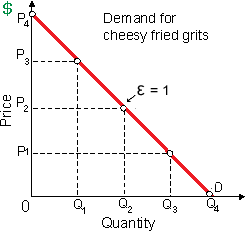
Greatest total revenue at price
In the demonstrated figure, total revenue is greatest for cheesy fried grits of Pixie at a price of as: (w) P1. (x) P2. (y) P3. (z) P4. Can someone explain/help me with best solution about problem of Economics...
In the demonstrated figure, total revenue is greatest for cheesy fried grits of Pixie at a price of as: (w) P1. (x) P2. (y) P3. (z) P4.
Can someone explain/help me with best solution about problem of Economics...
If one industry’s development stimulates development in support and complementary industries, it permits firms within the industry to: (i) move up their rising long run average costs curves. (ii) sell their products for higher prices. (iii) focus old technologie
For environmental quality the demand is income elastic for most people, that implies that prosperity and higher incomes tend to: (w) increase people’s concerns about air, water, and noise pollution. (x) reduce efforts to solve pollution problems
The marginal resource cost for the monopsonist in labor market which can’t discriminate the wage: (1) Is perfectly inelastic. (2) Lies beneath the market supply of labor. (3) Lies above market supply of the labor. (4) Is perfectly elastic.
Can someone please help me in finding out the accurate answer from the following question. Labor contracts having agency shop arrangements need: (1) Employees of a firm to give dues to the union. (2) The firm to hire just union members. (3) New employees of the firm t
A large negative GDP gap implies: A) an excess of imports over exports. B) a low rate of unemployment. C) a high rate of unemployment. D) a sharply rising price level.
I have a problem in economics on Proprietorships and corporations. Please help me in the following question. Most of the firms in United States are organized as ________, however two-third of all gain is received by the _________. (1) Corporations; restricted partners
The demand for gasoline would rise rapidly after a fifty percent: (i) Drop in the price of crude oil. (ii) Discovery of main latest oil supplies. (iii) Cut in public transportation fares. (iv) Cut in latest car prices. Q : Affects of costs and revenues in When the relative positions of all affects on costs and revenues are the same for all the several firms in this industry, in that case this firm is most likely operating in a: (w) differentiated oligopoly market in the short run. (x) monopolistically
When the relative positions of all affects on costs and revenues are the same for all the several firms in this industry, in that case this firm is most likely operating in a: (w) differentiated oligopoly market in the short run. (x) monopolistically
The benefits to sole partnerships and proprietorships associative to the corporations are that both contribute to: (1) Lack of permanence. (2) Limitless financial resources. (3) Limitless liability. (4) Simplicity of organization. Q : Problem regarding Collective Bargaining Can someone please help me in finding out the accurate answer from the following question. The union strategy which probably outcomes the maximum wages for both the union members and other workers over long run is: (1) Limiting ent
Can someone please help me in finding out the accurate answer from the following question. The union strategy which probably outcomes the maximum wages for both the union members and other workers over long run is: (1) Limiting ent
18,76,764
1933013 Asked
3,689
Active Tutors
1434270
Questions Answered
Start Excelling in your courses, Ask an Expert and get answers for your homework and assignments!!