--%>

Find linear demand curve by quantity and price graph

Along this illustrated linear demand curve, there is: (1) inelastic portion is range a. (2) elastic portion is range b. (3) midpoint is unitarily price elastic. (4) elasticity is constant in each and every ranges. (5) midpoint elasticity becomes infinite.
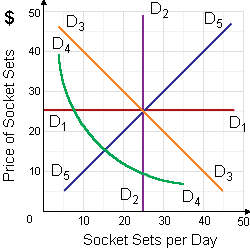
1993_Price Elasticity of Demand.png

Please choose the right answer from above...I want your suggestion for the same.

   Related Questions in Microeconomics

  • Q : Collective Bargaining-John Hicks model

    I have a problem in economics on Collective Bargaining-John Hicks model. Please help me in the following question. Sir John Hick’s model of the collective bargaining doesn’t describe: (1) Final wage settlements. (2) The period of strikes.

  • Q : Contestable markets and purely

    Contestable markets and purely competitive markets are related in that both: (w) consist of large numbers of firms. (x) consist of firms who are price takers. (y) are characterized by easy entry. (z) are characterized by large economies of scale.

  • Q : Vietnam divided into two different

    Why Vietnam divided into two different nations?

  • Q : Diagonal line in perfect equality of

    The ratio of the area among the diagonal line of perfect equality and the Lorenz curve to the total area in the diagonal is the: (1) poverty index. (2) human capital coefficient. (3) needs coefficient. (4) negative-tax index. (5) Gini index.

  • Q : Monopolistic competition in long run

    When this firm initially had important market power along with potential long-run economic profit, a likely cause of the firm finally being in a stable equilibrium of an $18 price and output of 5,000 units every day would be:  (1

  • Q : Functional Distribution of Income

    Computing the relative shares of national income accounted for by wages, interest, rent, and profit, yields, respectively measures called the: (1) market distribution of income. (2) functional distribution of income. (3) objective distribution of inco

  • Q : Purely competitive decreasing cost

    When a decreasing cost industry is purely competitive in that case: (1) each firm’s long-run supply curve is downward sloping. (2) each firm encounters increasing returns to scale. (3) growth of industry output yields lower per unit costs. (4) c

  • Q : Price elasticity inconsistent with

    Of the given price elasticities for market supply curves or market demand curves, and the one which is absolutely inconsistent along with standard economic theory would be one for that, across feasible ranges of prices as: (i) supply

  • Q : Outcome of a purely competitive market

    When cost conditions are otherwise identical, compared to the outcome of a purely competitive market, in that case a monopolist: (w) produces less and charges more. (x) maximizes total profits whenever possible. (y) confronts a demand curve where P =

  • Q : Maximizing firm profit conflicts with

    Whenever maximizing the firm profit conflicts with self-interests of business managers, this can lead to the: (i) Principal-agent problems. (ii) Negative accounting gain. (iii) Maximization of the revenues. (iv) Negative economic gain.

    Discover Q & A

    Leading Solution Library
    Avail More Than 1433487 Solved problems, classrooms assignments, textbook's solutions, for quick Downloads
    No hassle, Instant Access
    Start Discovering

    18,76,764

    1954496
    Asked

    3,689

    Active Tutors

    1433487

    Questions
    Answered

    Start Excelling in your courses, Ask an Expert and get answers for your homework and assignments!!

    Submit Assignment

    ©TutorsGlobe All rights reserved 2022-2023.