--%>

Explain Production Possibility curve

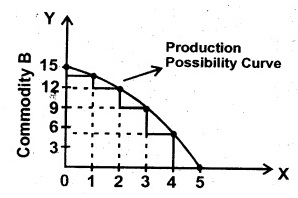
Elucidate Production Possibility curve with the help of a diagram?

Answer: The Production Possibility Curve refers to a curve that shows various production possibilities which can be produced with specified resources and technology.
920_PPC.jpg

When the economy devotes all its resources to the production of commodity B, it can generate 15 units however then the production of commodity A will be zero. There can be much production possibilities of commodity A & B. When we want to generate more commodities B, we have to decrease the output of commodity A and vice-versa.

   Related Questions in Microeconomics

  • Q : Calculating economic profit for first

    Assume that the banker is employed at an annual salary of $60,000. She as well has financial assets worth of $40,000 which earns $1,500 per year in interest. She too owns a commercial building that she rents out for $20,000 per year. Now assume that she quits this job

  • Q : Positively slope of short-run market

    Within purely competitive industries: (w) short-run market supply curves are positively sloped. (x) long-run market supply curves are positively sloped. (y) short-run supply is more elastic than long-run supply. (z) economic profit exceeds accounting

  • Q : Law of Diminishing marginal utility

    Describe the Law of Diminishing marginal utility? Answer: Law of Diminishing marginal utility: As a consumer goes on consuming more and more units of a commodity th

  • Q : Transactions increment and moves in

    Transactions increase and demand prices move below supply prices while a good turns into: (w) subsidized by the government. (x) subject to a high sales tax. (y) more technologically advanced. (z) a complementary by pr

  • Q : Wage Discrimination and Social Welfare

    The sum up of monopsonistic exploitation by the firm raises however the firm as well operates at a more socially and economically proficient level of output and employment whenever the firm is capable to engage in: (i) Blacklisting in its hiring of the labor. (ii) Yel

  • Q : Problem on equilibrium market price I

    I have a problem in economics on equilibrium market price. Please help me in the following question. The equilibrium market price subsists only if: (1) Quantity demanded equivalents the quantity supplied. (2) Surpluses exceed the shortages. (3) Expert

  • Q : Pure competitors in market structures

    Marginal revenue is not below the market price by the perspectives of simply: (i) monopolistic competitors. (ii) monopolists. (iii) cartel members. (iv) pure oligopolists. (v) pure competitors. Can

  • Q : Diminishing Marginal Utility of a good

    Whenever eating a whole pizza and realizing that the last piece didn’t taste almost as good as the first, you are experiencing is: (1) Diminishing the marginal utility. (2) Law of comparative advantage. (3) Law of income effect. (4) Law of supply.

  • Q : Normative goals of microeconomics

    Normative goals of microeconomics comprise: (w) economic growth. (x) price-level stability. (y) high employment. (z) equity within the distribution of income. Please friends choose one choice from the above. I want your suggestion

  • Q : Emergence and development of common

    The economist most intimately identified along with the emergence and early development of common equilibrium analysis was: (w) Adam Smith. (x) Leon Walras. (y) Alfred Marshall. (z) William Stanley Jevons. Can some